




The Nigerian government is no longer just flying its citizens home from South Africa — it now wants to make sure they are compensated for everything they left behind.
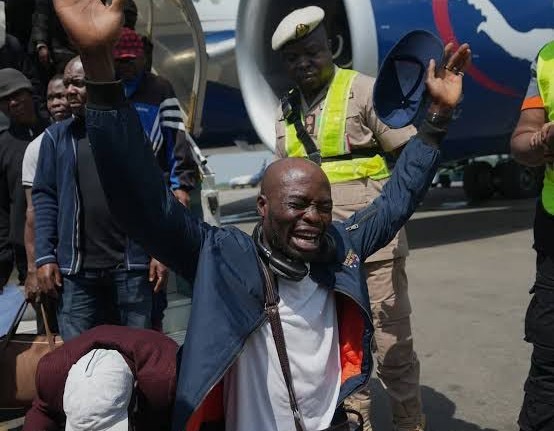
A third evacuation flight touched down in Lagos on Tuesday, July 1, 2026, carrying 269 Nigerians fleeing renewed anti-immigrant tensions in South Africa.
The flight, operated by Air Peace, brought the total number of government-evacuated Nigerians to 603.
That figure includes the 268 airlifted in the first batch on June 11 and 66 evacuated by ValueJet in the second batch on June 25.
The flights are part of five Air Peace operations approved by President Bola Tinubu following the screening and clearance of over 1,000 Nigerians by the Nigerian High Commission in Pretoria.
Senior officials of the Ministry of Foreign Affairs, led by the Director of African Affairs, Ambassador Haruna Ali Gombe, received the latest returnees at the airport and conveyed the President’s greetings.
The evacuation comes against the backdrop of a June 30 deadline issued by South African anti-migrant groups demanding that undocumented foreigners leave the country.
Anti-migrant demonstrations organised by groups including March and March took place across several South African cities on Tuesday, June 30.
Pretoria deployed 13,000 law enforcement officers, drones, helicopters, and more than 33,000 CCTV cameras across Gauteng Province to prevent a repeat of the deadly unrest that crippled South Africa in 2021 — a security operation that Acting Police Minister Firoz Cachalia said would cost approximately R600 million (about $35.5 million).
Nigeria to Pursue Compensation for Businesses and Properties Abandoned
Speaking on Channels Television‘s The Morning Brief as the third flight landed, Acting Nigerian High Commissioner to South Africa, Temitope Ajayi, said the government had already begun building a formal record of what evacuees left behind.
“In terms of the businesses, just three days ago, myself and the South African Deputy Minister of Finance were together and we were discussing this. I took up the discussion with her and we have agreed that we are going to ask our people who are returning to begin to document what they are leaving behind.”
He said returnees had been instructed to record their losses carefully before departing.
“I have asked them before they left yesterday to document very accurately those things they were leaving behind in terms of businesses, in terms of even cars, movable and immovable properties. We can now take it up with the South African government. That is the next step we are going to take.”
Ajayi also pushed back firmly against the characterisation of Nigerians in South Africa as undocumented.
He pointed to systemic delays in the South African Home Affairs department as the root cause of many Nigerians’ irregular status.
“In the last three or four years, there have been a deluge of applications at the South African Home Office which were not attended to due to systemic issues. So, because of this, many, not only Nigerian nationals, were caught in this web of delay, so you cannot rightly claim that these were undocumented because most of them came to the country legally.”
Nigerians on the Ground Say Security Deployment Kept Protests Calm
Despite fears of widespread violence, Nigerians still in South Africa reported that the June 30 protests were largely peaceful, thanks to the heavy security presence.
A Nigerian resident in Johannesburg who identified himself as Madueke told reporters that while protesters marched and sang, the military presence discouraged looting.
“They are marching and singing, but they are not destroying things as it’s usually the case because the government deployed the army to follow the protesters and ensure there is no destruction of properties and killing. Their target was just to loot the shops, especially that of people that sell foodstuffs, but the deployment of security agents has foiled their plan.”
Madueke, however, called on the Federal Government to dramatically scale up its airlift, warning that thousands of Nigerians were camped at the High Commission in Pretoria with nowhere to go.
“The government should bring more flights to take people back to Nigeria. Thousands of people are ready to go. The five flights they assigned can only take about one thousand people whereas many people are stranded and are willing to leave this country.”
The National Secretary of Igbo Union South Africa, Ezeanozie Eleberi, offered a sharper assessment. He insisted that the majority of Nigerians in South Africa have legal status, deep economic roots, and are not moving.
“For the records, the Nigerians voluntarily seeking to be repatriated are about 1,500 max. Many more are legal here, have lives, businesses and families here, have contributed significantly to the South African economy, so they are not moving.”
Eleberi was equally blunt about the anti-migrant organisers. “They didn’t bring us here and they can’t chase us out. They are not the government or law enforcement or immigration. They are just civilians trying to fight a perceived illegality with worse illegalities!”
Meanwhile, South Africa’s government issued a statement on Wednesday commending citizens who protested within the law.
It also reaffirmed its commitment to tackling immigration enforcement, border security, and policy gaps — while warning that those who used the protests as cover to loot would face criminal prosecution.
The Ministry of Foreign Affairs spokesperson, Kimiebi Ebienfa, confirmed that more evacuation flights were expected in the coming days.
He also advised Nigerians still in South Africa to “stay calm and security conscious, avoid routes and areas dominated by protesters” and remain in contact with the High Commission for updates.

 WhatsApp Channel
 Telegram Channel