

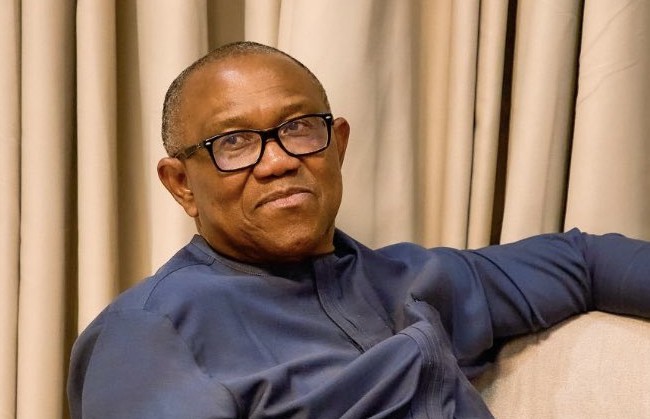
Former Anambra State governor and Nigeria Democratic Congress (NDC) presidential hopeful, Peter Obi, has defended his record of leaving office in 2014 with about 150 million dollars and ₦36 billion in state savings, insisting the funds were transparent, traceable and properly invested.
Speaking in a fresh interview with media entrepreneur Chude Jideonwo, Obi said the money was legitimately placed across three commercial banks and could be verified by anyone who cared to check the records.
He rejected suggestions that he secretly benefited from the deposits or diverted state funds into banks where he allegedly had personal ties, saying critics could keep their opinions but could not alter documented facts.
“Whatever you do, people have their views,” Obi said.
He broke down the balances he says he left behind, explaining that Anambra had 50 million dollars and ₦12 billion each in Diamond Bank (now Access Bank), Fidelity Bank and Access Bank when he handed over in 2014.
He said, “We had, for example, when I left, I had 50 million dollars in Diamond Bank… Same bank. Does Anambra State have the money? Anambra State savings… 50 million dollars in Fidelity Bank, which is supposed to be the bank I’m involved in… 50 million dollars in Access Bank.”
According to him, the dollar components were invested in fixed-income instruments at publicly known rates, and the state did not lose money on the placements.
He said, “Go to those banks. Let me start with the dollar. There are bonds; the rates are as issued. Everybody knows the rates. Go to them and see if there’s anyone who has been shortchanged.”
Obi also threw down a challenge to his critics and peers.
He said, “Today, who else has saved? Show me any other sub-national state in this country where a governor has left with savings. One. And I’ll stop running.”
Obi Says Tinubu Supporters Now ‘Selling Kuli-Kuli’
In the same interview, Obi turned to national politics and the 2023 presidential race, arguing that many Nigerians who backed President Bola Tinubu are now feeling the weight of economic hardship under his administration.
He said he believes his own support base has grown rather than shrunk because more citizens are judging leaders by lived reality rather than campaign rhetoric.
Obi said, “My fellowship has increased because those who jumped into, in quotes, some experiential thing… I was going to create the future.”
He argued that people who voted for Tinubu based on perceived experience and past performance have reconsidered their stance after watching the economy deteriorate.
He said, “Those who jumped into, in quotes, some experiential thing, ‘Oh, this man did this, this man did this’, I was going to create the future. I’ve seen that the whole thing was a mess.”
Obi painted a bleak picture of current conditions, saying it is hard for anyone in good faith to argue that Nigeria is on the right track.
He asked, “Nobody, nobody can tell you things are moving well. What are they going to do now?”
He added a pointed anecdote about collapsing livelihoods.
He said, “Those who had business when he came into power have collapsed. They are now the people who are selling kuli-kuli?”
Obi also took direct aim at the federal government’s “Renewed Hope” slogan.
He said, “You’re talking of the Renewed Hope. It had become hopeless when President Tinubu came into power.”
According to him, poverty, hunger and insecurity have all worsened since mid‑2023, with more Nigerians slipping below the poverty line and hunger indicators deteriorating.
He said, “We were number five below where we are today in hunger list. We’ve increased. Everything has gotten worse. Like I said before, we’re no longer talking of ghosts walking around. You can see where we’ve gotten.”
Obi argued that Nigerians are now forming their own verdict based on empty wallets, rising prices and daily insecurity, not on political spin.
Summing up his view of the current administration’s slogan, he said, “Which hope are they going to renew again? You can’t renew failure, and that’s it.”
Praise For Kwankwaso And Case For Human Capital
Obi also used the conversation to defend his relationship with former Kano State Governor Rabiu Kwankwaso, pushing back against those who label Kwankwaso’s political structure as a “structure of criminality.”
He described Kwankwaso as one of the few Nigerian politicians whose record shows a genuine concern for the poor and for lifting people out of poverty.
Obi said, “Kwankwaso is one politician that I can say it anywhere who cares for the interest of the poor.”
He added that Kwankwaso’s programmes, especially on education and skills, align closely with his own emphasis on human capital.
He said, “He believes in pulling people out of poverty. He believes in training a child of nobody to become something, and that for me aligns with my position.”
Obi reiterated that education and human capital development remain, in his view, the strongest foundation for any country that wants sustainable growth.
He said, “Truly, the biggest driver of development is education, human capital. It is not physical infrastructure, it’s human infrastructure.”
To make his point, he pointed to East Asian examples, saying countries that prioritised schooling, health and skills building transformed their economies in a few decades.
He said, “That’s what the Asian Tigers did. That’s what the Chinese did. That’s what Malaysia, that’s what everybody did.”
Obi said reducing Nigeria’s out-of-school population, improving healthcare and building a productive, export‑oriented economy would stay at the centre of his message as the country heads towards 2027.
For him, it is not enough to defend past savings or criticise current hardship; the real test is whether Nigeria can shift from what he calls “renewed hopelessness” to a model that invests heavily in people, not just projects.
If one former governor can still point to verifiable savings while a sitting government is accused of turning “Renewed Hope” into “renewed hardship,” whose record will ultimately shape how Nigerians vote when the next chance for a reset finally arrives?

 WhatsApp Channel
 Telegram Channel