

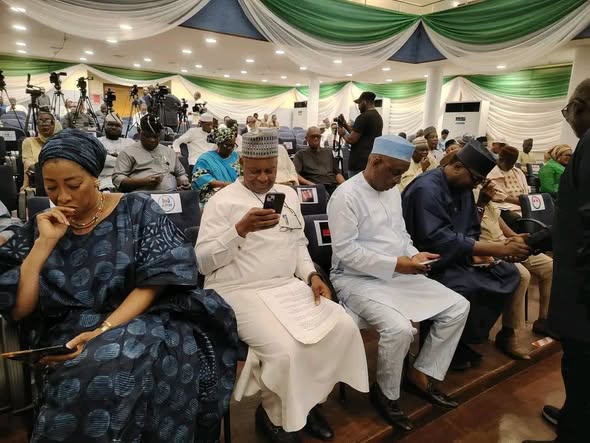
Nigeria’s opposition parties gathered in Abuja on Monday to explore a new framework for cooperation, proposing a Government of National Competence anchored on a single four-year transition term.
The summit, convened by the G100 at the Shehu Musa Yar’Adua Centre, brought together representatives of the African Democratic Congress (ADC), Allied Peoples Movement (APM), Nigeria Democratic Congress (NDC), Peoples Democratic Party (PDP), Peoples Redemption Party (PRP), and Social Democratic Party (SDP).
Presidential candidates Prince Adebayo Adewole of the SDP and Donald Duke of the PRP attended, alongside APM vice-presidential candidate Lawal Daura. ADC candidate Atiku Abubakar and NDC candidate Peter Obi were expected later.
Delivering opening remarks, Mallam Salihu Moh. Lukman said the proposed government would be built on competence, integrity, inclusion, and fair representation.
He explained: “The Framework before you proposes something more demanding than a merger of ambitions: a Government of National Competence, secured by a political commitment to a single four-year term, written into an enforceable Transition Charter.”
Lukman insisted that any agreement must be binding, saying “we want to underline the word ‘enforceable.’ Nigerian politics has never suffered from a shortage of sincere promises. What it has suffered from is promises that nobody could enforce when the person who made them changed his/her mind.”
Lessons From Past Elections
Tracing opposition history since 1999, Lukman recalled that parties contested separately in 2003, 2007, and 2011 but achieved victory in 2015 after agreeing on rules of engagement.
He said discipline collapsed in 2023 when opposition votes were split. “The winner took just under nine million votes. One opposition candidate took close to seven million. Another took just over six million. Thirteen million votes on one side, under nine million on the other. And the side with fewer votes formed the government, lawfully, constitutionally, and entirely predictably,” he said.
Lukman outlined three standing coalition bodies: a Central Leadership Committee of party leaders and candidates, a Publicity and Communication Committee, and a Legal Committee.
He also proposed five Working Groups to draft papers within four weeks on a National Covenant for Democratic Renewal, a Single-Term Transition Charter, a National Reform Programme, a Framework for Opposition Unity, and a Roadmap to a Common Presidential Candidate.
These documents would be presented at a second summit for adoption.
Clarifications And Warnings
Lukman stressed the summit was not asking parties to dissolve or merge immediately. “It is not asking any party to disappear into another party. It is not asking any candidate to stand down this morning. That question is not on the agenda of this Summit,” he said.
He warned that concealed positions or premature focus on outcomes had undermined past coalitions. “A hard line declared this morning is a problem that can be solved between now and the Second Summit. A hard line concealed this morning is a coalition that collapses in October,” he said.
Lukman said the G100 convened the summit with the Minority Caucus of the House of Representatives, without backing any candidate.
He invoked everyday hardships as justification, citing a woman in Kaduna who withdrew her child from school, a farmer in Benue displaced from his land, and a graduate in Aba who abandoned job hunting.
“They are entitled to something, and it is this: a real choice, presented by serious people, capable of governing. That is all a democratic opposition owes its country, and it is not a small debt,” he said.

 WhatsApp Channel
 Telegram Channel