



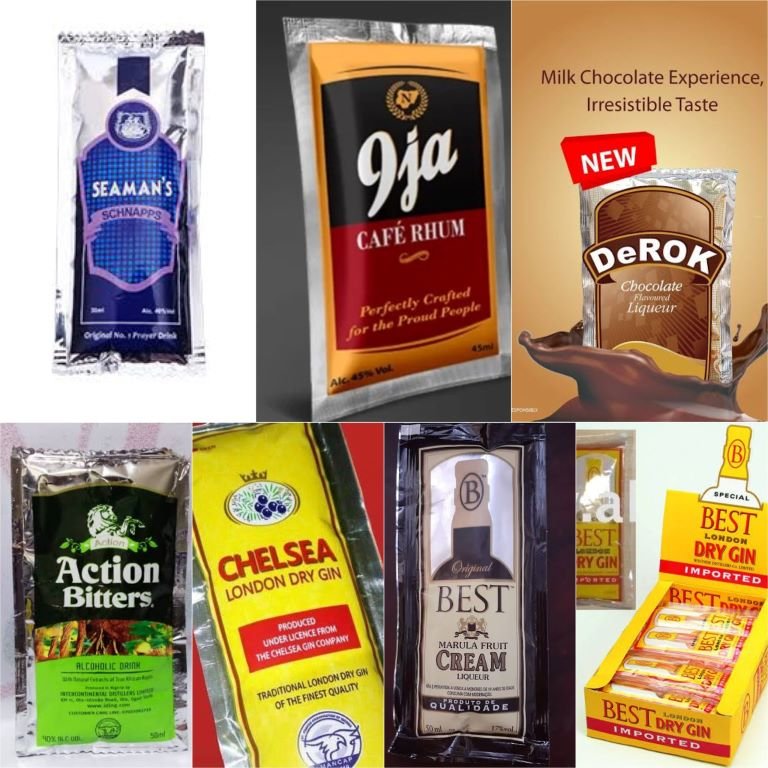
The National Agency for Food and Drug Administration and Control (NAFDAC) has started full enforcement of the federal government-approved ban on alcoholic drinks packaged in sachets and PET or plastic bottles below 200ml.
The agency warned manufacturers and distributors that any violation will attract strict regulatory sanctions.
NAFDAC said the enforcement followed the signing of an Irrevocable Enforcement Undertaking by the Distillers and Blenders Association of Nigeria (DIBAN), the Association of Food, Beverage and Tobacco Employers (AFBTE), and their member companies.
The document commits the companies to remove prohibited alcoholic products from the Nigerian market.
Speaking at a press briefing in Lagos on Monday, NAFDAC Director-General, Prof. Mojisola Adeyeye, said the policy is meant to protect public health, especially children and young people.
She said the concern over small-pack alcohol dates back to 2018, when regulators found that such products were cheap, easy to hide and widely available to minors.
How The Policy Developed
The discussions involved NAFDAC, the Federal Ministry of Health, the Federal Competition and Consumer Protection Commission (FCCPC), DIBAN and AFBTE.
After those talks, a five-year moratorium was granted in 2019 to give manufacturers time to switch to larger packaging and phase out sachet alcohol.
The first deadline expired on January 31, 2024, but enforcement was delayed again after further consultations.
The Federal Government later extended the transition period to December 31, 2025.
The ban officially took effect on January 1, 2026, and covers alcoholic drinks in sachets, PET bottles below 200ml and glass bottles below 200ml.
What NAFDAC Found
NAFDAC said research backing the policy showed that minors were easily accessing these products.
It said 47.2 per cent of minors and 48.8 per cent of underage drinkers obtained alcohol in sachets, while 41.2 per cent of minors and 47.2 per cent of underage drinkers got them in PET bottles.
The agency said enforcement began with manufacturers in January 2026 after the Senate gave legislative backing.
It added that any banned products found inside factories during the first phase were removed and destroyed.
NAFDAC later launched a nationwide mop-up exercise in July 2026, targeting markets, motor parks, bars, retail shops, warehouses and distribution centres.
What Manufacturers Must Do
Affected manufacturers have been told to begin a nationwide recall of all banned products already in circulation.
NAFDAC said the recalled products will be verified and destroyed under its supervision, with the manufacturers bearing the cost.
Factories that have been sealed will only reopen after companies prove that the production lines for the prohibited package sizes have been dismantled, disabled or reconfigured.
They must also comply fully with recall orders, pay required charges, destroy the products and receive NAFDAC certification before reopening.
Companies that fail to comply risk continued closure, placement on the NAFDAC Regulatory Watchlist, suspension or cancellation of product registration and possible criminal prosecution.

 WhatsApp Channel
 Telegram Channel




Okay then, we are watching. The people who are heavily reliant on these drinks would really be disappointed.