


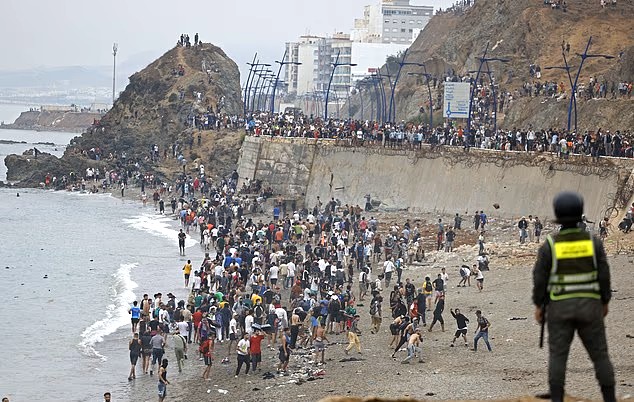
More than 60,000 migrants crossed overnight from Morocco into Spain’s North African enclave of Ceuta, triggering a humanitarian and political crisis for Madrid.
A police source told another online media, AFP, that many crossed by swimming around the small border barrier where it meets the Mediterranean Sea, discarding flotation rings and clothing used during the risky passage.
At least 60 people have died attempting to reach the enclave, which has a population of about 85,000, according to the same police source.
Spanish Prime Minister Pedro Sánchez, who visited Ceuta’s Tarajal border on Friday, July 31, described the mass influx as “a violation of Spain’s territorial integrity” and said the government would use all available resources to protect residents.
Sánchez Blames Trafficking Networks for the Surge
Sánchez blamed the unprecedented crossings on human trafficking networks, which he said exploited a recent Spanish Supreme Court ruling preventing the immediate return of migrants intercepted at sea near Ceuta or Spain’s other North African enclave, Melilla.
“That has spread like wildfire during these last few hours through the networks of mafias that traffic in human beings and has produced an avalanche of the characteristics and dimension that we experienced yesterday,” Sánchez said.
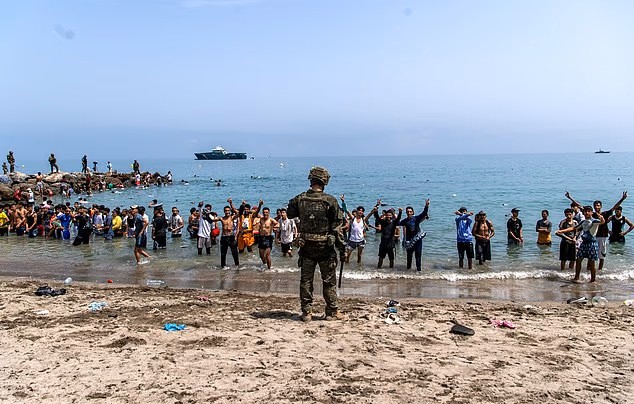
The prime minister announced plans for a temporary reception centre to handle documentation, registration and expedited removal of migrants with no legal basis to remain in Spain, along with a visible buoy barrier near Tarajal beach to mark the border in compliance with the court ruling.
Spain’s Interior Ministry, which deployed additional police and soldiers, said more than 37,500 migrants had voluntarily crossed back into Morocco by Friday afternoon. Madrid also sent divers, drones and boats to boost security in the enclave.
European Reactions Split as Diplomatic Tensions Rise
Italy announced it would suspend Schengen border-free travel arrangements with Spain for one month, meaning travellers moving by air or sea between the two countries must now present passports, despite the countries not sharing a land border.
The move followed comments from Italian Foreign Minister Antonio Tajani blaming Spain’s migrant regularisation programme for encouraging trafficking, prompting Spain to summon Italy’s ambassador and accuse Tajani of “partisan demagoguery.”
The European Commission clarified that Ceuta and Melilla operate under special Schengen rules preventing migrants from moving freely into the rest of the border-free zone.
EU Migration Commissioner Magnus Brunner described the situation as “unacceptable” and said he remains in close contact with Spanish authorities.
Ireland’s Justice Minister Jim O’Callaghan expressed solidarity with Spain and, as part of Ireland's Presidency of the Council of the European Union, requested an emergency meeting of the EU’s Integrated Political Crisis Response mechanism.
The current influx far exceeds the previous mass crossing in May 2021, when around 10,000 migrants entered Ceuta over two days.
Rachid Sbihi, head of a workers’ association representing Spain’s Guardia Civil officers, described the situation as “a serious humanitarian crisis,” saying thousands of migrants, including unaccompanied children, have been left sleeping in parks and on pavements.
“It’s chaotic,” he said, adding that many of those who died drowned during the crossing while others were killed in a crush near the breakwater fence at Tarajal beach.
Moroccan government sources told another online media, Europa Press, that criminal organisations were responsible for the crossings, while insisting Rabat’s cooperation with Spain remains “exemplary.”





Hmm, Chai, these people migrating risking their lives to cross such dangerous waters, that is pure desperation. They clearly saw an avenue, a gap of diplomatic boarder technicality and decided to encroach.