

Nigeria’s Federation Account Allocation Committee (FAAC) has released a fresh wave of funds, disbursing a total of ₦1.92 trillion to the federal government, states, and local councils for November.
The disbursement was reached at FAAC’s December 2025 meeting in Abuja, chaired by Minister of State for Finance, Doris Uzoka-Anite.
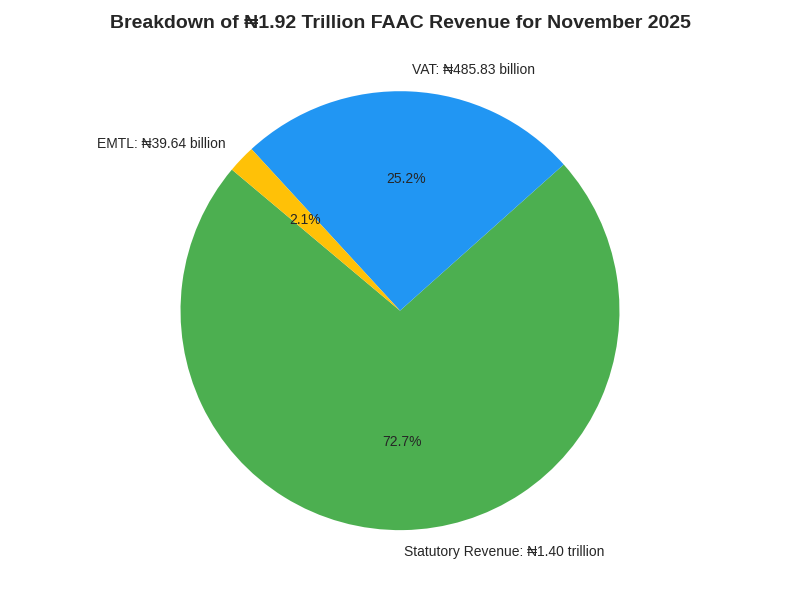
The committee’s communiqué revealed that the distributable pool comprised ₦1.40 trillion from statutory revenue, ₦485.83 billion from value-added tax (VAT), and ₦39.64 billion from the electronic money transfer levy (EMTL).
In total, ₦2.34 trillion was available, but deductions followed: ₦84.25 billion for collection costs and ₦330.62 billion for transfers, interventions, refunds, and savings.
Statutory receipts fell sharply, dropping to ₦1.736 trillion from ₦2.164 trillion in October — a decline of ₦427.97 billion.
VAT also weakened, sliding to ₦563.04 billion from ₦719.82 billion. From VAT proceeds, ₦22.52 billion was deducted for collection costs, while ₦54.68 billion went to transfers and refunds.
Breakdown of Allocations and Revenue Trends
From the ₦1.92 trillion shared, the federal government received ₦747.15 billion, states ₦601.73 billion, and local councils ₦445.26 billion.
In addition, ₦134.35 billion — representing 13% of mineral revenue — was distributed to oil-producing states as derivation.
A deeper breakdown showed that from statutory revenue alone, the federal government took ₦668.33 billion, states ₦338.98 billion, and councils ₦261.35 billion.
From VAT, the federal government received ₦72.88 billion, states ₦242.92 billion, and councils ₦170.04 billion. EMTL proceeds added ₦5.95 billion for the federal government, ₦19.82 billion for states, and ₦13.88 billion for councils.
Key Highlights
- ₦1.40 trillion statutory revenue – the largest share, making up the bulk of the allocation.
- ₦485.83 billion VAT – a significant portion, though notably lower than October’s VAT receipts.
- ₦39.64 billion EMTL (Electronic Money Transfer Levy) – the smallest slice, but still part of the distributable pool.
This visualization makes it clear that statutory revenue dominates the FAAC distribution, while VAT remains an important secondary contributor. The EMTL, though modest, reflects Nigeria’s growing reliance on digital transaction levies.
FAAC noted that excise duty posted a modest increase, but nearly all other major revenue streams — petroleum profit tax, hydrocarbon tax, company income tax, capital gains tax, stamp duties, oil and gas royalties, import duty, CET levies, VAT, and EMTL — recorded significant declines.
The numbers tell a sobering story: Nigeria’s revenue base is shrinking even as allocations remain high.
So, can we sustain this level of disbursement without running into fiscal crisis soon? Or is FAAC simply papering over cracks in our fragile fiscal system for political reasons?
Rate, Like 👍, Comment 💬, Share this article, Follow us on our social media handles, and Submit your own story to get featured and earn rewards!
 WhatsApp Channel
 Telegram Channel