
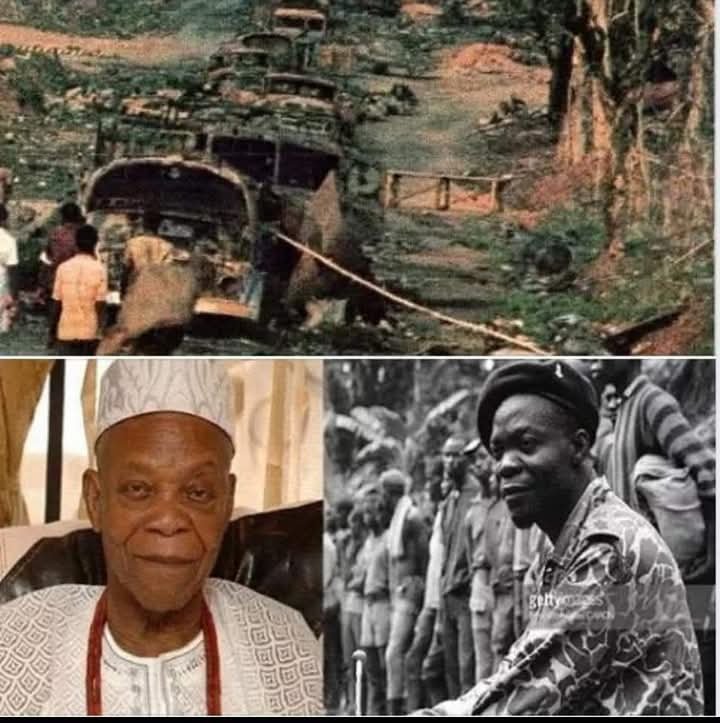
On March 31, 1968, in the quiet town of Abagana in present-day Anambra State, history took a dramatic turn. Nigeria was in the thick of a brutal civil war (1967–1970), a conflict that followed the declaration of the Republic of Biafra. What began as political tension after independence had spiraled into one of Africa’s most devastating wars, marked by famine, displacement, and immense human suffering.
For many young Africans today, the Nigerian Civil War can feel distant, almost abstract. But at the time, it was deeply personal. Families were torn apart. Cities were reduced to rubble. Survival itself became an achievement.
Yet, even in the middle of this hardship, moments of courage emerged—moments that reminded people of their strength. One such moment was the Abagana Ambush.
As one survivor would later reflect, “War shows you the worst of humanity, but sometimes, it also reveals unexpected courage.”
The Strategic Importance of Onitsha
Before Abagana, there was Onitsha—a crucial commercial city along the River Niger. Control of Onitsha meant access to vital supply routes and a gateway into the heart of Biafra. Nigerian federal forces had attempted several times to capture the city, facing stiff resistance from Biafran troops.
When they finally succeeded in March 1968, it was seen as a major breakthrough.
The Nigerian 2nd Division, led by Colonel Murtala Mohammed, was determined to press the advantage. Their next objective was clear: advance toward Enugu, the former Biafran capital, and link up with the 1st Division. If successful, this would tighten their grip on Biafran territory and potentially bring the war closer to a swift end.
Confidence was high among Nigerian troops. One officer reportedly remarked, “We believed the road ahead was ours. Nothing stood between us and total victory.”
But war has a way of humbling even the most confident armies.
The Convoy That Seemed Unstoppable
The Nigerian convoy that left Onitsha was massive and intimidating. It stretched for kilometers—over 100 vehicles carrying approximately 6,000 soldiers, along with heavy weapons, ammunition, and fuel supplies.
To anyone watching, it looked unstoppable.
The soldiers were battle-hardened, well-armed, and backed by superior resources. Compared to them, Biafran forces were often poorly equipped, relying on ingenuity and improvisation to survive.

But sometimes, strategy outweighs strength.
As the convoy moved through the narrow roads toward Enugu, it unknowingly entered one of the most carefully anticipated ambush points of the war.
Major Jonathan Uchendu: Calm Under Pressure
Watching from a concealed position was Major Jonathan Uchendu of the Biafran army. He was not commanding the largest force, nor did he have superior weapons. But what he had was patience, discipline, and a deep understanding of the terrain.

Uchendu knew that attacking too early would be disastrous. His men, tense and eager, struggled to understand his restraint.
“Why are we waiting?” some whispered among themselves.
But Uchendu remained firm. “Not yet,” he instructed quietly.
He allowed the convoy to move deeper into the ambush zone, ensuring maximum vulnerability. His plan depended on timing—one wrong move could cost them everything.
Later, he would recall, “Leadership is not about reacting to fear. It is about controlling it.”
The Ogbunigwe: Innovation Born from Necessity
One of the defining elements of the Biafran war effort was the creation of locally made weapons known as “Ogbunigwe,” which roughly translates to “mass killer” in Igbo.
These were not conventional weapons. They were improvised explosives—crafted under extreme conditions, often with limited materials. Yet, they proved devastatingly effective when used strategically.
The Biafrans had learned to adapt. With limited access to international arms, they turned to creativity and engineering.
As one Biafran engineer reportedly said, “We did not have what we needed, so we built what we could. Survival became invention.”
At Abagana, the Ogbunigwe would play a decisive role.
The Moment That Changed Everything
As the convoy advanced, tension built. Uchendu’s men remained hidden, waiting for the signal.
Then, unexpectedly, everything changed.
A nervous soldier accidentally fired an Ogbunigwe rocket.
For a brief second, time seemed to pause.
Then came the explosion.
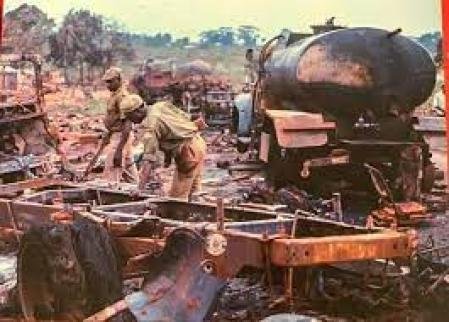
The rocket struck a fuel tanker within the convoy, triggering a massive blast. Flames erupted instantly, spreading from vehicle to vehicle. Ammunition ignited, causing secondary explosions that turned the entire road into a blazing inferno.
The tightly packed convoy became a trap.
Soldiers were caught off guard—many had no time to react. Vehicles collided, overturned, or burned. Smoke filled the air, and confusion spread rapidly.
A witness would later describe it: “It was like the ground itself had turned against them. Fire everywhere, noise everywhere—no escape.”
Turning Chaos into Victory
Seizing the moment, Uchendu gave the command: “Now!”
Biafran forces launched their attack from multiple directions. Hidden in bushes, behind trees, and along elevated ground, they opened fire on the disoriented Nigerian troops.
Reinforcements joined in, intensifying the assault.
The Nigerian soldiers, already shaken by the explosions, struggled to regroup. Some fled. Others tried to fight back but were overwhelmed by the chaos.
What had started as an accident quickly turned into one of the most devastating ambushes of the war.
Colonel Murtala Mohammed narrowly escaped, reportedly evacuating by helicopter.
The scale of destruction was immense. Thousands of soldiers were killed, and a significant amount of military equipment was destroyed or captured.
More Than a Battlefield Victory
For Biafrans, the Abagana Ambush was not just a military success—it was psychological.
At a time when resources were scarce and hope was fading, this victory sent a powerful message: they could resist. They could fight back.
It became a symbol of resilience.
As Uchendu later reflected, “At first, we were afraid. But fear did not stop us. We had no choice but to stand our ground.”
For young Africans today, this story carries an important lesson. It is not a celebration of war, but a reminder of human determination under pressure.
Lessons for a New Generation
The Abagana Ambush offers more than history—it offers perspective.
Strategy can overcome strength. Innovation can emerge from limitation. Courage often appears in the most difficult moments.
But it also reminds us of the cost of conflict. The Nigerian Civil War claimed over three million lives – according to several accounts, many due to starvation and disease.
So while Abagana stands as a moment of tactical brilliance, it also sits within a larger story of suffering and survival.
As one historian put it, “We must remember these victories, but we must also remember why peace matters.”
From History to Legacy
Today, Abagana is no longer a battlefield. It is a living community, a place where ordinary life continues. But beneath its quiet surface lies a story that still echoes through time.
For Afripeadia, stories like this matter. They connect young Africans to their past—not just to remember, but to learn, reflect, and grow.
Because history is not just about what happened.
It is about what we choose to carry forward.
“If you understand where you come from,” one elder once said, “you will better understand where you are going.”
Like 👍, Comment, share this article, and Follow us on our social media handles.