


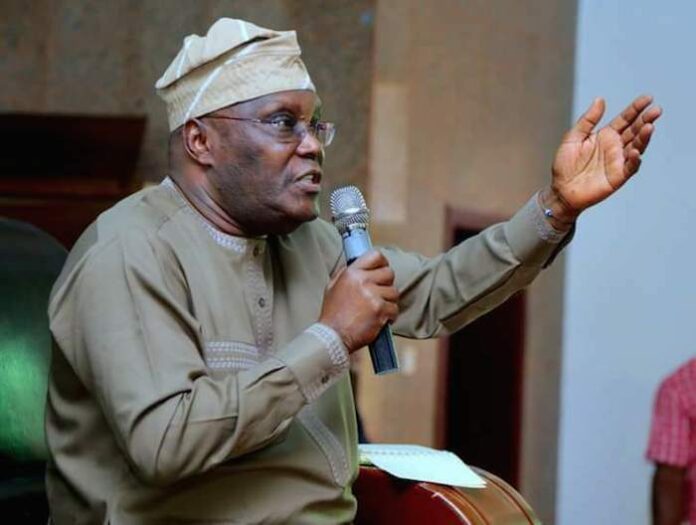
Former Vice President Atiku Abubakar has accused President Bola Ahmed Tinubu’s administration of double standards over its handling of the petroleum sector, arguing that government cannot claim to have ended fuel subsidy while still granting tax credits and other fiscal incentives to major oil and gas operators.
In a statement issued on Sunday in Abuja by his Senior Special Assistant on Public Communication, Phrank Shaibu, Atiku said the celebration of subsidy removal was misleading because Nigerians have continued to bear the cost of government intervention in the sector through other forms of spending.
Atiku said the controversy has grown sharper since he unveiled his Atiku Economic Recovery Plan (AERP), which proposes a capped, transparently managed intervention to soften the impact of high energy costs on households while boosting domestic refining.
“Tinubu stood at Eagle Square and declared that subsidy was gone. Petrol prices exploded, transportation costs soared, food prices followed, businesses buckled and household purchasing power collapsed… But when major oil investors knock on Tinubu’s door, the sermon changes. Suddenly, government intervention is good economics; tax credits are necessary; fiscal concessions are strategic,” the statement said.
He pointed to tax credits available to qualifying deep offshore oil and gas projects as an example of what he called selective intervention, asking: “So, what exactly is Tinubu’s objection: government intervention itself, or government intervention for Nigerians?”
NNPC Figures Show Billions Still Spent On “Energy Security”
Atiku questioned government’s description of petroleum-sector spending since subsidy removal, citing figures from the Nigerian National Petroleum Company (NNPC) Limited’s audited accounts.
He said the company’s 2023 accounts recorded about ₦4.84 trillion in energy-security expenses and related shortfalls, while its 2024 accounts recorded about ₦7.13 trillion under the same heading, arising partly from exchange-rate differences between the regulated petrol price and the rate used to settle import obligations.
“In plain English, government was still absorbing a price differential after Tinubu had triumphantly announced that subsidy was gone… Whether government calls it subsidy, under-recovery, shortfall or energy security, public resources were being used to bridge a gap between economic cost and the price at which petrol was sold. You cannot abolish subsidy at the podium and resurrect it in the accounts under an alias,” he said.
Atiku Calls For Disclosure Of Oil Tax Credit Beneficiaries
Atiku argued the real question is not whether government should intervene in the economy, but whether that intervention protects corporate investment or shields ordinary Nigerians from hardship.
“Tinubu cannot operate two economies in one country — savage capitalism for poor Nigerian families and compassionate capitalism for big oil operators,” he said, distinguishing his AERP proposal from the old subsidy system by describing it as capped, independently audited and built with a defined exit plan.
He called on the Federal Government to disclose the beneficiaries and value of major petroleum tax credits, remissions and concessions.
“Nigerians deserve to know the beneficiaries of major petroleum tax credits, remissions and incentives, the value of revenue surrendered, the investments delivered in return and whether Nigerian investors have equal and transparent access to comparable incentives,” he said, adding: “You cannot subsidise capital and criminalise relief for citizens.”
Obi Backs Subsidy Removal, Faults Its Management
Peter Obi, presidential candidate of the Nigeria Democratic Congress (NDC), has weighed in on the debate but disagreed with Atiku’s direction.
President Tinubu removed fuel subsidy on May 29, 2023, declaring “subsidy is gone,” a decision that has since been followed by sharp increases in commodity prices, transportation fares and other costs.
Atiku, who did not initially oppose the removal, recently pledged to restore subsidy if elected in 2027, telling Hausa-language platforms in a livestreamed interview that the policy had failed to improve Nigerians’ lives.
Speaking on Monday at the Nigerian Bar Association (NBA) conference in Port Harcourt, Obi said mismanagement of the proceeds from subsidy removal should not be a reason to reverse the policy.
“I subscribe and maintain that you need to remove subsidy. Mismanagement of the proceeds shouldn’t be the reason for not removing it… What we have today is that, that removal and the attendant resources being recovered is also being mismanaged and stolen. For example, we have received, according to them, ₦16 trillion,” Obi said, adding that his own leadership plan would have removed subsidy in an organised manner and invested the savings for public benefit.
The disagreement has spilled beyond the political class. In an opinion piece, commentator PastorKay argued in support of Atiku’s position, saying Nigeria must put citizens’ welfare at the centre of economic policy, that cheaper fuel could ease transportation and food costs, and that any new intervention must come with transparency, independent auditing and a focus on strengthening local refining rather than enriching middlemen.
The writer said the real test should not be whether government intervenes, but whether ordinary Nigerians actually feel the benefit — a question likely to remain central to the subsidy debate as the 2027 campaign intensifies.

 WhatsApp Channel
 Telegram Channel

Mr Atiku sir I support you, what you are saying is true, let us call a spade a spade, if you want to be strict be that way to everybody, don’t change face when it comes to businesses. Ride on sir, you are speaking truths.
My President, Mr Peter Obi sir, you are also right, they mismanaged funds so terribly, the state that I am resident in, apart from the few infrastructures which do not benefit the society exhaustively, I can not say I have seen one direct investment of the state allocated funds.