




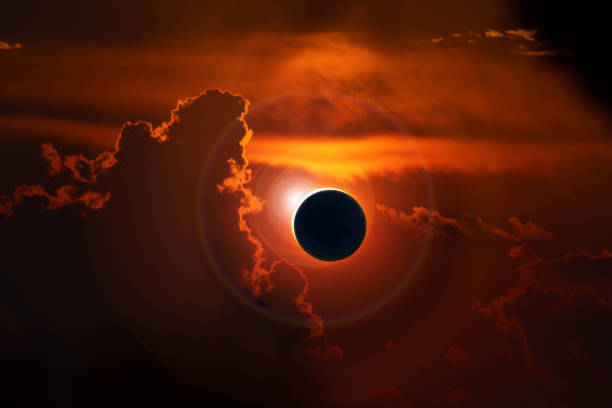
Day will briefly turn into night across parts of northern Spain on August 12, when a rare total solar eclipse sends the Moon’s shadow racing across Europe.
The event will be the first total solar eclipse visible from mainland Europe since 2006 and will draw skywatchers along a narrow track from Russia to the Atlantic.
A solar eclipse happens when the Moon passes directly between the Sun and Earth, casting a tight band of shadow over the planet and turning daylight into an eerie twilight.
During totality, temperatures can drop, shadows twist into strange shapes and animals sometimes behave as if night has suddenly fallen.
Modern science explains this as a “cosmic coincidence” because “even though the Sun is about 400 times bigger than the Moon, it is also about 400 times farther away,” which makes them appear the same size from Earth and allows the Moon to cover the Sun completely and reveal its glowing corona.
On August 12, the first landfall for the total eclipse will be in a remote region of northern Russia before the path of totality sweeps across Greenland, Iceland, northern Spain and a small corner of northeastern Portugal.
In Spain, the shadow will cross roughly from the northern city of Oviedo towards the island of Mallorca, giving observers along this line the chance to experience full darkness just before sunset.
How Long It Lasts, How Rare It Is, And How To Watch Safely
In Spain, the total phase will last under two minutes, with the city of Burgos, for example, entering darkness for about one minute and 48 seconds.
Totality will last slightly longer in parts of Russia and Greenland but will still stay under two-and-a-half minutes, while the partial phases before and after totality will stretch to about one hour and 45 minutes.
Outside the narrow path, a partial eclipse will be visible across most of Europe, Canada, the northern United States and northwest Africa, as the Moon appears to take a bite out of the Sun rather than covering it completely.
Total solar eclipses happen once or twice a year somewhere on Earth, but because the shadow path is so narrow, a single location might wait centuries—up to 400 years—for another chance to see totality.
Spain will see more sky events soon: on August 2, 2027, a long “eclipse of the century” will cross southern Spain, northern Africa and the Arabian Peninsula with a total phase of six minutes and 23 seconds, followed by an annular “ring of fire” eclipse over southern Spain on January 26, 2028.
Yes, you still need protection.
It is dangerous to look directly at the Sun at any point before or after totality, because the rays can burn the retina without pain, and symptoms only show up later.
Experts recommend certified eclipse glasses that meet the ISO 12312-2:2015 standard for direct solar viewing, since ordinary sunglasses are not enough to block the harmful UV and visible light.
After a total solar eclipse in the United States in 2024, online searches for “my eyes hurt” spiked, a reminder that even short, unprotected glances at the Sun can cause lasting damage.

 WhatsApp Channel
 Telegram Channel