


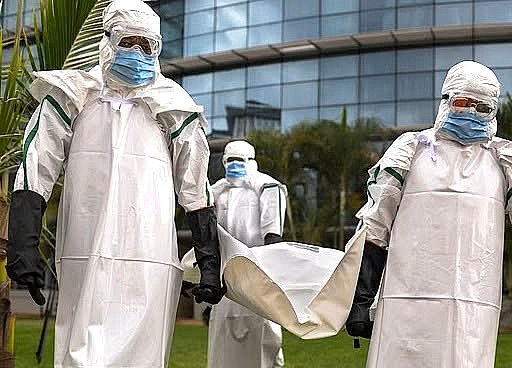

The head of the Africa Centers for Disease Control and Prevention (Africa CDC) has delivered a blunt assessment of the continent’s Ebola outbreak: the fight is not being won.
Confirmed cases have surpassed 10,000 and total deaths are approaching 5,000, according to data compiled by the World Health Organization (WHO).
“I have worked on Ebola outbreaks for more than 30 years. I have never stopped feeling the weight of each life lost,” Africa CDC Director-General Jean Kaseya said.
“Yesterday I stood before more than 40 African Ministers and said what the data tells us: we are not winning so far. 10,172 confirmed cases. 4,932 people are gone.”
Kaseya made the remarks during an extraordinary meeting of African health ministers convened to evaluate the surge and reinforce a unified, continental response.
The Epicentre and the Spread
The ongoing health emergency, caused by the Bundibugyo species of the Ebola virus, was first declared in the Democratic Republic of the Congo (DRC) in May 2026.
The epicentre remains in the DRC, which accounts for 10,141 confirmed cases and 4,928 deaths across eight affected provinces as of late October.
Elsewhere, Kenya has reported nine confirmed cases and two deaths. Uganda has recorded 20 confirmed cases and two deaths, alongside one probable case and one probable death.
France and Nigeria have each recorded one imported case with zero fatalities. Nigeria’s single confirmed case involved an individual with recent travel history to Uganda who tested positive on October 20.
The patient was subsequently evacuated to Switzerland for specialised medical care. The Nigeria Centre for Disease Control and Prevention (NCDC) continues to monitor 54 identified contacts linked to the case.
Ministers Agree on Cross-Border Measures
Health ministers at the meeting agreed to elevate readiness for potential importations and coordinate cross-border surveillance.
They also agreed to keep commercial borders open while tightening health monitoring protocols.
“Ebola anywhere in Africa demands preparedness everywhere in Africa,” Kaseya added. “We will get there, together.“
He said the current trajectory requires aggressive preparation even in jurisdictions currently reporting zero cases.
Reflecting on the 2014–2016 West Africa Ebola crisis, Kaseya described how unchecked transmission disrupts wider society.
During that outbreak, approximately five million children faced educational disruptions, 23,000 children lost parents, and nearly $3 billion in economic output was lost.
“We already know what an uncontrolled Ebola outbreak costs,” Kaseya observed. “The data is hard to hear, but it is also our best chance to change course.”