





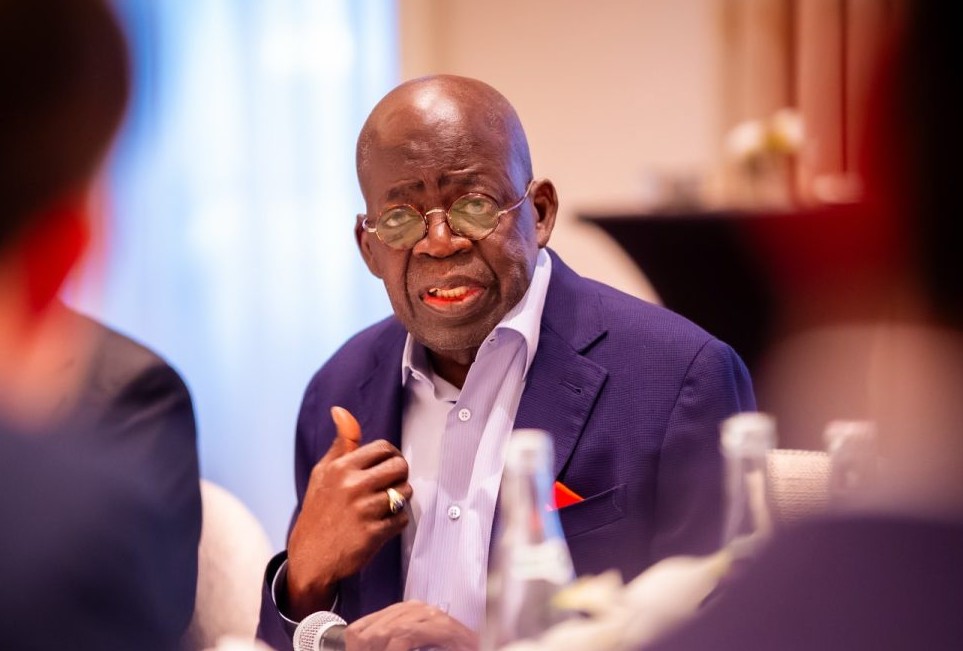
President Bola Tinubu arrived in Nairobi, Kenya, on Tuesday to lead a high-powered Nigerian delegation at the Africa Forward Summit. The gathering took place at the Kenyatta International Convention Centre.
This summit, co-hosted by President William Ruto and French President Emmanuel Macron, serves as a pivotal platform for Africa-France relations. Over 30 heads of state attended the event.
Other key figures included UN Secretary-General António Guterres and AU Commission Chairman Mahamoud Youssouf. Together, they opened discussions on economic fairness and global political restructuring.
During the summit, President Tinubu engaged in vital diplomacy. He held a bilateral meeting with Madagascar’s President, Michael Randrianirina, to discuss trade and regional cooperation.
Furthermore, he met with Patrice Motsepe, the President of the Confederation of African Football. During their talk, Tinubu confirmed Nigeria is ready to host the 2026 CAF awards.
Commitment to the Blue Economy and Maritime Safety
President Tinubu identified the blue economy as a primary driver for continental growth. He noted that insecurity in the waters has long prevented the business community from investing.
The President then made a significant regional offer. He pledged to share Nigeria’s Deep Blue Project intelligence with neighboring countries to secure the Gulf of Guinea.
He said: “Today, I make an explicit commitment: Nigeria will intensify regional coordination by offering our Deep Blue Project’s maritime intelligence infrastructure as a shared data hub for willing Gulf of Guinea states.”
The President explained that maritime sovereignty is essential for attracting private capital. He believes that functional courts and secure sea lanes are the foundations for industrial growth.
He stated: “Let no one misunderstand: maritime sovereignty does not repel investment — it attracts it. Secure sea lanes, predictable regulation, and functional courts are the preconditions that unlock private capital.”
Nigeria also endorsed the Nairobi Declaration during the proceedings. This document reaffirms that ocean governance is the non-negotiable base for Africa’s economic transformation and shared resilience.
Tinubu stated: “For Africa, moving from sea blindness to ocean sovereignty is not a choice — it is a generational duty. Nigeria is ready, and we invite all present to join us in that duty.”
Demanding Reform of the Global Financial System
The President used the platform to advocate for a change in the international financial architecture. He alleged that the current system quietly de-industrialises African nations.
He pointed out that Africa still holds less than 2% of global manufacturing value. This remains true despite decades of independence and vast natural resources.
The President said: “We export raw minerals, crude oil, and agricultural commodities, and we import processed goods at a premium. This pattern is not an accident.”
He argued that the system starves African industries of affordable capital. Meanwhile, competitors enjoyed much easier conditions when they were building their own industrial bases.
Tinubu clarified that Nigeria has already made difficult sovereign choices. These include removing fuel subsidies and exiting the Financial Action Task Force (FATF) grey list.
He noted: “Nigeria does not come to this discussion as a supplicant. We come as a nation that has taken painful, homegrown decisions to put our house in order.”
These choices have strengthened external reserves to $45.5 billion. Despite this, the President revealed a heavy burden for the coming year.
The $11.6 Billion Debt Servicing Challenge
President Tinubu revealed that Nigeria will spend approximately $11.6 billion on debt service in 2026. This massive sum accounts for nearly half of the projected revenue.
He argued that these funds should be going into steel mills and textile factories. Instead, high interest rates are draining the national treasury and stalling industrial growth.
He said: “Every single dollar that leaves our treasury to pay punitive interest rates is a dollar that did not go into our steel sector, our textile mills, our agro-processing plants, or our digital industries.”
The President questioned why African borrowers face costs ten times higher than those in Europe. He believes this gap prevents cross-border value chains from forming.
He asked: “How can an African manufacturer compete with a competitor in Europe, Asia, or North America when the cost of borrowing in our nations is five to ten times higher?”
He concluded that the current financial setup acts as an instrument of industrial disarmament. Nigeria, he said, is demanding a system that enables local processing and refining.
He stated: “Nigeria is not asking for charity. We are demanding a financial system that intentionally enables Africa to industrialise.”
Migration and Human Capital Investment
The President also addressed the root causes of irregular migration. He believes that providing jobs and security at home is the only way to reduce the desperation of smugglers’ trucks.
He said: “People who have jobs, security, and hope at home do not typically risk their lives in the back of a smuggler’s truck.”
Consequently, he called on international partners to invest in African productive sectors. He wants Official Development Assistance (ODA) to be used for programmes that create genuine choices for youth.
The Nigerian delegation included top cabinet members like Minister Bianca Odumegwu-Ojukwu and Taiwo Oyedele. They met with counterparts to discuss AI, digitalisation, and healthcare.
Business giants like Aliko Dangote and Tony Elumelu were also present. They focused on moving from political rhetoric to concrete industrialisation strategies across the continent.
Nigeria remains committed to the African Continental Free Trade Area (AfCFTA). The delegation continues to seek investment opportunities that align with Africa’s demographic advantage.

 WhatsApp Channel
 Telegram Channel


I personally do not understand why President Tinubu is making such a huge gate without formal compliance from other states, we send in our own intelligence in exchange for what? Also it is quite shocking to say the least, I did not know that Madagascar now had a seating president, last I heard, the last one fled. None the less, it is good that the free trade agreement is still in effect, and with active involvement. And honestly if Namibia can clear all the debts so can Nigeria, we just need to stop borrowing and build a system where we… Read more »