

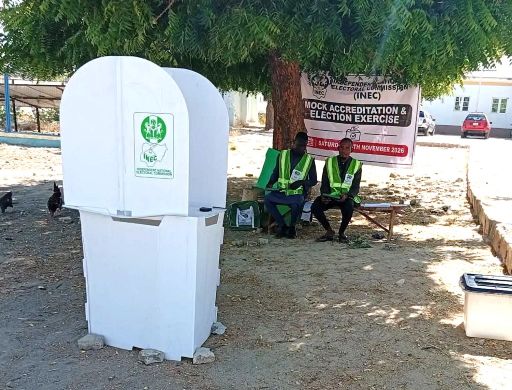
Nigeria’s preparations for the 2027 general elections have suffered an early setback after the nationwide mock accreditation and voting exercise conducted by the Independent National Electoral Commission (INEC) exposed several technological and logistical problems.
The exercise, held on Saturday, November 28, was designed to test the commission’s election technology, accreditation procedures and readiness to transmit results electronically.
However, reports from different parts of the country revealed malfunctioning Bimodal Voter Accreditation System (BVAS) machines, missing names on voter registers, absent electoral officials and poor voter participation.
The exercise covered 17,676 polling units nationwide.
At Madikpo Tokunbo Market polling unit, only 11 of the 754 registered voters participated in the accreditation exercise.
The turnout was similarly low at LGEA Primary School in Wurukum, Benue State, where only six out of 833 registered voters were accredited.
At Mbajuku One polling unit in Agan Ward, just three voters participated.
These figures have drawn attention to the challenge of getting Nigerians to participate in election preparations even when the exercise is intended to improve the voting process.
BVAS Machines Experience Technical Difficulties
The BVAS is one of the central technologies used in Nigeria’s elections.
It captures voters’ biometric information, including fingerprints and facial images, to verify their identities before accreditation.
The system also supports the electronic transmission of polling-unit results through INEC’s result management infrastructure.
However, some polling units reported difficulties with fingerprint recognition and facial verification during Saturday’s exercise.
Other complaints involved delays in the arrival of electoral officers and materials.
Election observers also reported problems with the electronic uploading of result sheets.
Election observer organisation Yiaga Africa identified cases where BVAS machines failed to scan and upload result sheets despite repeated attempts by presiding officers.
Yiaga also identified gaps involving polling-unit configurations across 47 wards.
The organisation’s findings raised concerns about whether the commission could resolve the identified problems before the 2027 elections.
Missing Voter Names and Poor Public Awareness
Another major complaint concerned voters whose names were missing from the registers used during the exercise.
Some residents reportedly arrived at their designated polling units only to discover that their details were unavailable.
An INEC staff member, Salamatu Idris, attributed some complaints to delays in the distribution of Permanent Voter Cards (PVCs).
She explained that some people who registered in June and July were yet to receive their cards.
Idris said the commission planned to distribute the outstanding PVCs between December 1 and 7.
However, inadequate public awareness also contributed to the poor turnout.
In Kogi State, where the exercise covered the three senatorial districts, several polling units recorded very low participation.
Some residents who spoke to reporters said they were unaware of the exercise.
INEC Chairman Had Promised Improved Election Technology
INEC Chairman, Professor Joash Amupitan, had earlier described the mock exercise as an important test of the commission’s preparations.
The commission introduced the exercise to identify weaknesses before the actual elections.
The 2027 general elections will be closely watched following controversies surrounding the electronic transmission of results during the 2023 presidential election.
INEC’s IReV portal, which allows Nigerians to view uploaded polling-unit result sheets, became a major subject of controversy during that election.
The commission has since promised improvements to its technology and election management procedures.
However, Saturday’s exercise has shown that technical reliability, voter awareness and effective deployment of electoral personnel remain important challenges.
INEC is expected to examine the reports from the exercise and address identified problems before the next general elections.