



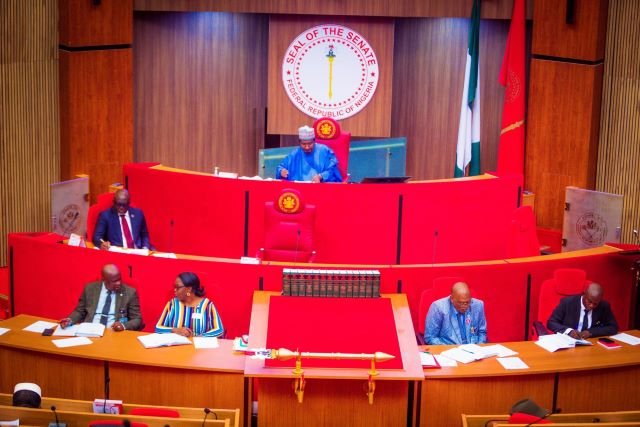
The Senate has approved a total of ₦403.1 billion for the Nigerian Police Trust Fund (NPTF) to support policing and strengthen the fight against terrorism, kidnapping and other violent crimes over the next two fiscal years.
Lawmakers said the new funding is intended to boost the operational capacity of the Nigeria Police Force at a time when Nigerians are increasingly worried about rising insecurity in many parts of the country.
Under the package, the upper chamber approved ₦170.1 billion for the Police Trust Fund’s 2025 fiscal year and a further ₦233 billion for the 2026 fiscal year.
The 2026 envelope covers personnel, capital projects and overheads, with the goal of improving equipment, infrastructure, logistics and training for police personnel nationwide.
Senators expressed hope that the funding will enhance the provision of critical tools and facilities needed to respond to terrorism, kidnappings, banditry and urban crime.
They also linked the approval to persistent calls from citizens for government to tighten security and give frontline agencies the resources required to do their jobs effectively.
The debates came against a backdrop of repeated attacks and abductions in several states, which have increased pressure on the federal government to show tangible progress on security.
Tinubu’s New Criminal Justice Bill
Alongside the Police Trust Fund approval, President Bola Tinubu has sent a fresh criminal justice bill to the Senate, seeking to overhaul the legal framework that governs how crimes are investigated, prosecuted and tried in Nigerian courts.
The proposal seeks to repeal the Administration of Criminal Justice Act, 2015, and replace it with a new Administration of Criminal Justice Act, 2026.
A key feature of the bill is the creation of a criminal justice monitoring council that will oversee implementation of the law in courts within the Federal Capital Territory and other federal courts across the country.
In his letter to the Senate, read during plenary, Tinubu said the proposed law is designed to tackle procedural bottlenecks and long-standing challenges that have slowed down trials and weakened public confidence in the justice system.
According to the President, the bill also seeks to align Nigeria’s criminal justice architecture with emerging global practices by promoting the use of technology in court processes.
He said the draft law introduces new measures aimed at improving case management, reducing delays and ensuring that relevant institutions carry out their roles more effectively.
The bill has been referred to the Senate Committee on Judiciary, Human Rights and Legal Matters for detailed consideration and report, in line with parliamentary procedure.

 WhatsApp Channel
 Telegram Channel