



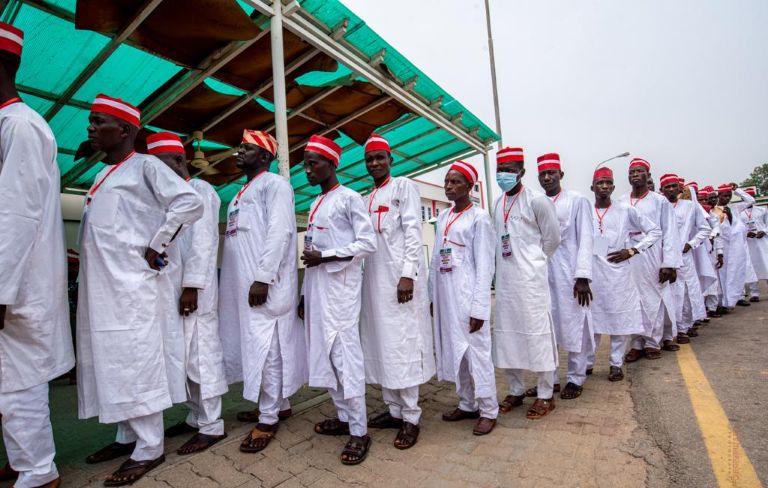
The Kano State Government is preparing to spend ₦1.5 billion to marry off 1,500 couples in one ceremony — and this time, the invitation is open to everyone, regardless of religion.
The upcoming edition of Kano’s “Auren Gata” — meaning “marriage for the privileged” in Hausa — is taking shape as the most ambitious version yet of a programme that has become one of northern Nigeria’s most distinctive social welfare initiatives.
The Kano Hisbah Board, the state’s Islamic advisory and compliance body, is coordinating the exercise under the administration of Governor Abba Kabir Yusuf.
The Commander-General of the Hisbah Board, Sheikh Aminu Daurawa, confirmed that 5,000 people applied for the programme, from which 3,000 individuals — forming 1,500 couples — will be selected as beneficiaries.
The government intends to spend ₦1 million on each couple, covering dowry support, empowerment funds, and household items.
“Each groom will be given the sum of N100,000 for dowry to their brides and N100,000 token for the brides as empowerment and also provide them with beds, mattresses, furniture and food items,” Daurawa said.
All applicants undergo HIV, hepatitis B, pregnancy, and genotype tests before being confirmed as participants.
Beyond medical screening, Daurawa said the board also verifies that each groom is employed and has accommodation available for his bride.
The programme is not new. Kano conducted a similar mass wedding in October 2023 for 1,800 couples.
The Hisbah Deputy Commander, Sheikh Mujahideen Aminuddeen, confirmed that three Christian couples participated in that edition — and the current programme remains open to all faiths.
“The mass wedding is opened to all intending couples, like widows, widowers, divorcees, spinsters and bachelors,” Aminuddeen said.
Government Targets Orphans and the Underprivileged — With Strict Conditions
Governor Yusuf’s administration is specifically targeting orphans and families that cannot afford the cost of a traditional wedding, Aminuddeen said.
All beneficiaries are screened and verified before selection, a process designed to ensure public funds reach those who genuinely need them.
One condition attached to participation stands out: couples who go through the mass wedding cannot divorce without the consent of the Hisbah Board.
The clause reflects the programme’s stated goal of building stable families, not just facilitating ceremonies.
A Kano resident, Jamila Suraja, expressed support for the initiative but raised a concern about motivation.
She said the programme had benefited many vulnerable families but worried that some couples in previous batches had allegedly entered marriages mainly to access government support rather than to build lasting homes.
Another resident, Hassan Maikadara, was more straightforwardly positive, saying the programme gave many people who wanted to marry but lacked financial means a genuine path forward.
Economists and Sociologists Say the Programme Has Broader Social Value
Two experts offered wider perspectives on what the mass wedding initiative represents beyond the ceremony itself.
Economist Dr Abdulsalam Kani framed it as a poverty-reduction tool with real economic potential — if properly implemented.
“One of the major root causes of rampant divorce in the northern part of Nigeria is poverty. You cannot get married if you don’t have a means of livelihood. We need to understand that empowerment will only succeed if those who are going to be empowered have a particular skill or are into a particular trade,” he said.
Sociologist Dr Muhammad Hadi-Musa placed the programme in a broader policy context, describing it as one of northern Nigeria’s most visible social interventions.
“Kano has arguably recorded several visible gains from such programmes. The initiative has helped normalise simpler and more affordable wedding models, challenging excessive ceremonial spending that often delays marriage. It has also reinforced the idea that public institutions can participate in family-support policies rather than limiting interventions to infrastructure and economic sectors alone.”
The exact date for the upcoming mass wedding has not yet been announced. Meanwhile, the Hisbah Board says preparations are in top gear.
The Kano government is spending ₦1.5 billion of public funds to marry off 1,500 couples — and then requiring those couples to get government permission before they can divorce. In your view, does the government now feel its marital largesse gives it right to interject itself into the private affairs of these citizens?