

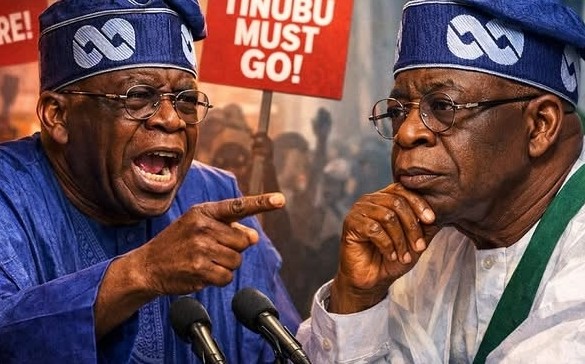

In this column, the author contrasts President Tinubu’s current governance with his fierce opposition playbook against past leaders. What if Tinubu faced Tinubu? A revealing look at hypocrisy, strategy, and the opposition’s failure to fight fire with fire.
In today’s Saturday Tribune column, I set Tinubu’s actions as president against the blistering response he himself would have mounted if he were in opposition, drawing on his own record to show how sharply the two diverge.
You may resent Bola Ahmed Tinubu, but you can’t deny that he has earned his place in Nigerian political history as one of the, if not the, most consequential opposition figures in Nigeria’s Fourth Republic.
He constructed a carefully planned political and rhetorical template to oppose central governments effectively and then converted the symbolic capital he gained into a path to the presidency.
By May 29, Tinubu will mark his third year as president.
He is beset by the same constraints his predecessors faced and is reacting to opponents almost exactly as they did, perhaps with even more viciousness and guile.
But the opposition seems to be in the wilderness.
It is flustered, incoherent, spineless, and in strategic disarray.
It would do well to study how an opposition Asiwaju Bola Ahmed Tinubu would have confronted an increasingly tyrannical and devious President Bola Ahmed Tinubu.
If Bola Ahmed Tinubu were in opposition today, watching a president preside over widening and deepening oceans of blood and rising insecurity, constrict the space for alternative parties, intensify economic hardship and offer only perfunctory condolence optics amid horrendous mass slaughters.
He would launch a sustained, strategic, organized, merciless and unsparing regime of critical engagement using every available medium.
We know this because we have a record of him doing precisely that.
Tinubu’s Opposition Playbook on Insecurity
My recollection of his key moves as an opposition politician aren’t intended to be exhaustive.
They are merely representative.
In March 2013, for instance, in remarks widely reported at the time, Tinubu said that if President Goodluck Jonathan could not guarantee security, he should “honorably resign.”
By November 2014, his tone had hardened.
According to TheCable, Tinubu said that in any serious country Jonathan would have resigned over the scale of insecurity in the country.
In the same 2014, he accused Jonathan’s government of “failure, lack of capacity, vision and creativity” and of misleading Nigerians about the true state of security.
That is the vocabulary Tinubu reaches for when he is not in power.
He did not treat insecurity as a complicated policy arena deserving of cautious language.
He treated it as evidence of unfitness for office.
“insecurity equals loss of legitimacy.”
An aggregation of all his statements about the insecurity that pervaded the country when Jonathan was in government (which has become worse on his watch) amounted to this: insecurity equals loss of legitimacy.
That was one of his most potent rhetorical blitzkriegs against Jonathan, which traveled beyond the shores of Nigeria.
Economic Distress and Calls for Resistance
The same pattern holds for economic distress.
On January 11, 2012, in an article published by PM News, Tinubu attacked Jonathan’s removal of fuel subsidy, dubbing it the “Jonathan tax.”
He said the policy breached the social contract between the rulers and the ruled, described it as a punitive imposition on the poor and, crucially, urged Nigerians to resist it.
He wrote that citizens had a duty to “peacefully demonstrate and record their opposition.”
That line matters.
It shows that Tinubu, in opposition, does not merely diagnose hardship.
He authorizes not just rhetorical dissent but physical rebellion against it.
Following his exhortation, there were disabling, convulsive and fatal nationwide protests and strikes.
Tinubu aligned himself with that mood.
He did not urge patience.
He gave moral and political cover to resistance.
Some even said he funded the protests, called “Occupy Nigeria,” in which at least 12 people died.
It ultimately forced Jonathan to reverse the withdrawal of subsidies, which Tinubu is now implementing with more soullessness than Jonathan ever did.
He also does not leave resistance unorganized.
On February 6, 2013, opposition parties merged into what became the All Progressives Congress.
Tinubu was one of the principal architects of that coalition.
The merger’s stated aim was to end corruption, insecurity and economic stagnation.
It was a calculated attempt to convert grievance into power.
Tinubu did not wait for electoral cycles to do their work.
He engineered an alternative.
Confronting Institutional Threats
When he believed the Jonathan administration was using institutions against the opposition, he said so without equivocation.
In January 2014, during the Rivers State political crisis, Tinubu described the disruption of opposition activity as “a frontal assault against democracy” and even a “coup against democracy.”
In November 2014, after the chaos at the National Assembly, he again held Jonathan responsible.
He saw pattern, not accident, and he said it plainly.
He went further.
In October 2014, when Jonathan sought legislative approval for a $1 billion loan to fight Boko Haram, Tinubu opposed it.
He argued that the funds could be used for political purposes rather than security.
In other words, he was willing to recast even security spending as partisan maneuvering.
That instinct has not been erased by time.
Now bring this record forward.
On April 2, 2026, President Tinubu met victims of the Plateau killings at the airport rather than visiting affected communities, with the presidency citing time and logistical constraints.
Strip away the explanations and look at it from the vantage point of opposition Tinubu.
This is the sort of image he historically converts into a political weapon.
He would not defend it.
“citizens had a duty to ‘peacefully demonstrate and record their opposition.'”
He would amplify it as proof of cold detachment and deadly incompetence.
In fact, the seemingly intractable and worsening sanguinary communal upheavals that are spreading all over the country and the rising mass abductions for ransom that seem to be unabating would have constituted more than sufficient grounds for opposition Tinubu to delegitimize the presidency of President Tinubu.
There is also the matter of political space.
Tinubu’s own rise was made possible by the constellation of opposition forces.
The 2013 merger was a deliberate construction of an alternative to an incumbent he portrayed as incompetent and anti-democratic.
If he were outside power today and perceived any effort, real or imagined, to frustrate the emergence of rival parties, such as we are seeing with the ADC, he would not respond with restraint.
His record from 2013 to 2015 shows a readiness to build countervailing structures and to accuse incumbents of undermining democracy.
In early 2013 when there were credible fears that INEC might block or frustrate the registration of the new opposition merger that became the APC, including the controversy over a rival party using the same acronym, Tinubu framed any attempt to deny registration as authoritarian sabotage of democracy by the president.
Tinubu’s stance as opposition was confrontational and absolutist.
When he was outside power, he interpreted procedural or institutional resistance in maximalist terms as existential threats to democracy, not routine political or legal friction.
And he routinely blamed it on the sneaky wiles of the president, not the institutions that were responsible for the actions he railed against.
Opposition Tinubu would have put the blame for INEC’s withdrawal of recognition of the David Mark-led leadership of the ADC squarely on President Tinubu’s desk and would have called it Tinubu’s fascist, cowardly, fear-inspired strangulation of a rival, oppositional political space.
Lessons for Today’s Opposition
What emerges from this is not a series of isolated reactions but a coherent oppositional method.
Tinubu indicts insecurity as presidential failure, frames economic pain as betrayal, promotes and legitimizes physical public resistance, works to consolidate opposition power and heaps all blames for the misfortunes of the opposition on the president.
He combined rhetoric with organization.
He did not do half measures.
“Power is not donated; it is taken.”
Tinubu in opposition would not recognize the defenses now offered on behalf of Tinubu in power.
He would reject them, loudly and repeatedly, and he would mobilize against them.
Criticism of Bola Ahmed Tinubu on the grounds that his NADECO-era allies or Southwest loyalists no longer protest policies they had consistently condemned misses a basic truth about power.
People rarely mobilize against themselves, their benefactors or the networks that sustain them.
Expecting otherwise is naïve.
The more useful lesson is not to lament their silence but to study Tinubu’s own playbook when he stood outside power.
He exemplified disciplined opposition, coalition building, strategic messaging and relentless pursuit of institutional leverage.
Those outside the orbit of power should stop waiting for insiders to revolt and instead organize to displace them.
Power is not donated; it is taken. Tinubu has proved that.
The opinions expressed in this article are strictly those of the author and do not necessarily align with the views of JolibaLive News! or any of its staff members. The author is in no way associated with this online news blog.