


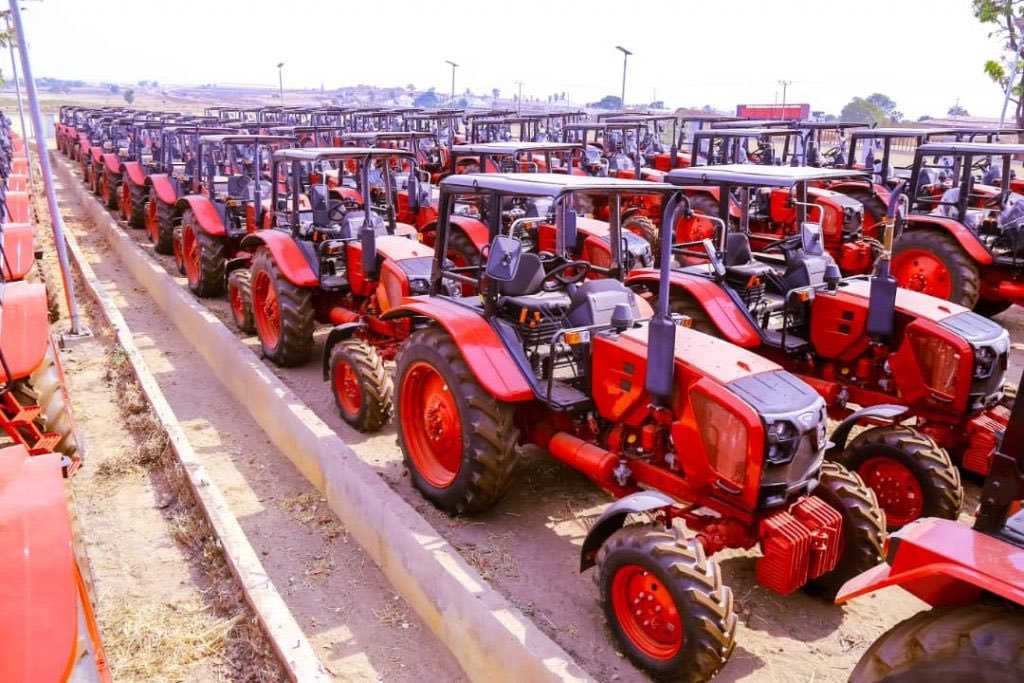
The federal government has unveiled a sweeping mechanisation programme that will deploy 2,000 tractors and more than 9,000 precision implements nationwide.
The government says the initiative is to transform food production and strengthen national food security.
Minister of Agriculture and Food Security, Abubakar Kyari, announced the rollout in Abuja. He said the first phase will deliver 600 tractors, followed by 750 and then 650 units.
“This is not merely an equipment rollout, it is the ignition of a National Agricultural Productivity Revolution,” Kyari declared.
He described the Renewed Hope National Agricultural Mechanisation initiative as the largest of its kind ever undertaken on the African continent.
More than 10,000 applications have already been received for the first phase.
Kyari clarified that tractors will not be handed out to individuals. Instead, they will be allocated to certified mechanisation service providers to ensure broad access.
“These tractors are not distributed for private ownership. Each tractor, with the capacity to service approximately 600 hectares per year, becomes a multiplier of productivity,” he explained.
The programme is expected to support over 1.2 million farmers and cover more than 1.5 million hectares annually.
Each tractor will come with two years of free service support, while mobile workshops and mechanisation centres will be established nationwide.
Building Domestic Capability
Kyari said the initiative is designed to build industrial capacity, not dependency.
Plans include seven mega mechanisation centres and a domestic tractor assembly plant capable of producing between 2,000 and 4,000 units annually.
The programme is backed by a ₦50 billion agricultural finance facility supported by the World Bank, Heifer International, and other technical partners.
The funding will empower smallholder farmers and boost agro-industrial capacity.
Minister of State for Agriculture and Food Security, Aliyu Abdullahi, noted that Nigeria’s mechanisation density of 0.27 horsepower per hectare remains far below global and African averages.
“If you have 10,000 hectares of rice and rely on manual labour, it will take so long, but with mechanised equipment, it can be completed within days,” he said.
Abdullahi explained that farmers will access equipment through mechanisation service centres, avoiding the cost of ownership.
He stressed that implementation will be inclusive, particularly for women who contribute about 70% of agricultural production processes. “We will continue to partner with them as we deepen mechanisation,” he added.
The initiative should deliver food security, job creation, and economic resilience.
By reducing Nigeria’s mechanisation deficit, the programme could reshape agricultural productivity and strengthen national food sovereignty.
Rate, Like 👍, Comment 💬, Share this article, Follow us on our social media handles, and Submit your own story to get featured and earn rewards!
 WhatsApp Channel
 Telegram Channel