

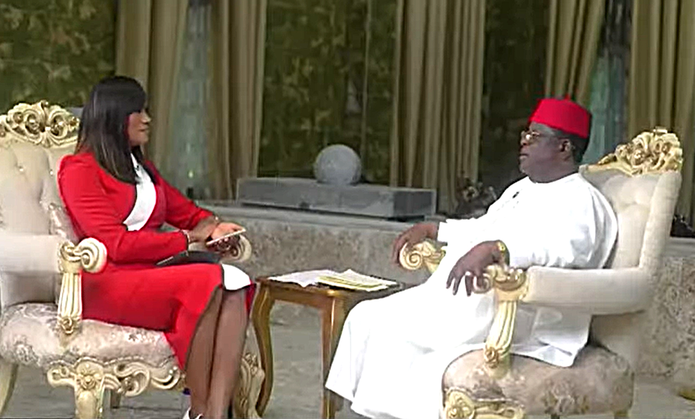
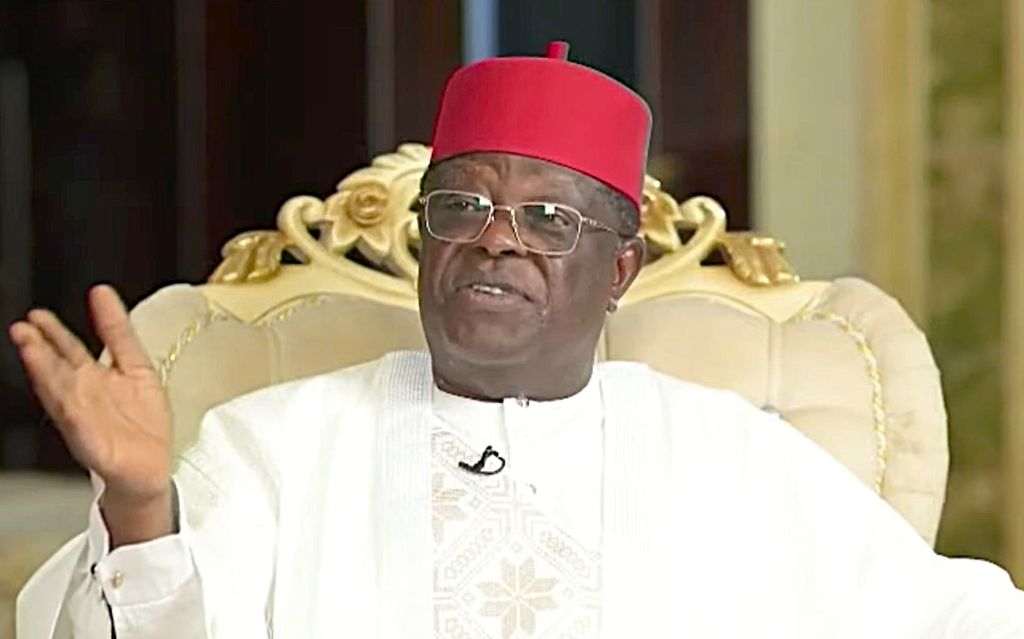
Nigeria’s Minister of Works, David Umahi, has spoken candidly to ARISE News anchor Ojy Okpe about the Lagos-Calabar Coastal Highway, one of President Bola Tinubu’s flagship projects.
In the interview, he explains why there is no single design for the 750-kilometre road, defends its cost and the direct procurement of Hitech Construction, accuses Landmark of land grabbing, and sets a three-year completion target. He also weighs in on Peter Obi’s Southeast presidential credentials and ambitions.
The Interview
Q Is there a single engineering design for the entire 750-kilometre highway?
Ans No. There is no one single design for the 750 km of Lagos-Calabar Coastal Highway.
“There is no one single design for the 750 km of Lagos-Calabar Coastal Highway.”
Q Then what existed before this administration started construction?
Ans What was done in 2006 was a concept. The route had been gazetted, but it still needed detailed engineering work before individual sections could be built.
Q So how does the government proceed?
Ans We study and design section by section. You have to do the ESIA, you have to do the soil investigation, you have to do the engineering design. Design work is ongoing for the Edo, Delta and Bayelsa sections, and engineering decisions on difficult terrain will determine the final alignment, bridges and other structures.
Q Is there a single Environmental and Social Impact Assessment for the whole road?
Ans There is no single ESIA for the entire 750 kilometres. Provisional environmental assessments are done for the relevant sections before work begins, and the process continues as designs are finalised. Section One now has its full environmental assessment, and we are complying with the required processes as construction progresses.
Q Critics say parts of the original coastal route have been abandoned for the East-West Road. Is that true?
Ans No. The alignment is intact. The roughly 400-kilometre East-West Road reconstruction approved by President Tinubu is an additional connection to the Coastal Highway, not a replacement. It is part of our wider goal of integrating the Lagos-Calabar corridor with other major federal roads, creating alternative routes and opening up economic activity across the southern states.
Cost and Value for Money
Q Some critics put the total cost at ₦15 trillion. Is that figure right?
Ans Who fixed the ₦15 trillion? You cannot take the cost of the section under construction in Lagos and multiply it across 750 kilometres. We are procuring in sections, so we can only determine costs as each section is designed and approved. The terrain, structures and engineering requirements differ substantially along the route.
Q Why can’t a uniform per-kilometre cost be applied?
Ans There are no two sections that are the same. Bridges, soil conditions and other engineering requirements ultimately determine the cost of each section.
Q Section One is reported at about ₦1.06 trillion for 47.47 kilometres. Isn’t that excessive?
Ans Not when you assess it properly. When normalised to a standard two-lane carriageway, it comes to approximately ₦7.3 billion to ₦7.5 billion per kilometre, or about $5.5 million at the exchange rate I used. That compares favourably with the Bodo-Bonny Road, the East-West Road and coastal road projects elsewhere in West Africa. I deserve kudos for the cost of the coastal highway.
“You have to compare apple to apple.”
Q What specifications explain the price?
Ans The highway is being built with reinforced concrete pavement, solar lighting, underground drainage, two-metre walkways, crash barriers and a corridor reserved for a railway line. On the Lagos section, about 30 kilometres required removing unsuitable material to an average depth of about 10 metres and raising the road level by about five metres. You remove the pit, average of 10 metres, and then you fill it back.
Q Has the rising cost of materials affected the contract?
Ans Yes. When we started, concrete was ₦350,000 per cubic metre. Today, it is ₦460,000 per cubic metre. The contract price has not changed.
Q Have outside financiers examined the pricing?
Ans They have. Deutsche Bank led the financing for Section One and examined the project before the financing was syndicated. They said the project was underpriced, and the financing was oversubscribed by $100 million.
Procurement and Hitech Construction
Q Was there any public advertisement or open bidding for the highway?
Ans There was direct procurement. It’s within the law.
“It’s within the law.”
Q What procurement routes does the law allow?
Ans There are three kinds of procurement that are allowed, and there is a fourth, which is emergency procurement. Open procurement involves public advertisement. Restrictive tendering lets government invite companies considered to have the necessary expertise to pre-qualify and bid. The third is direct procurement, where there are no competitive bids, but it is a specialised kind of procurement.
Q Why was direct procurement used for Hitech?
Ans Our job was to construct a road along the coast, and we knew we would be confronted with the ocean surge. We needed specialised coastal engineering expertise, and Hitech had demonstrated it with Eko Atlantic.
Q What is that track record?
Ans Over the years, the Federal Government engaged expatriates from Belgium, from France and elsewhere. Each time the flood came, there would be another intervention, but it could not solve the problem of Victoria Island. The President asked Hitech to invest to tame the Atlantic Ocean. They said no, that it would liquidate them. They were almost liquidated until they came up with a method using massive concrete structures and geotextile materials. Today we have a beauty to behold, the Eko Atlantic.
Q How did the approval process go?
Ans Hitech put Eko Atlantic forward as evidence of performance, capacity and capability to the BPP. The BPP looked at it and said, yes, but procure this thing in sections. We obtained a Certificate of No Objection and took it to the Federal Executive Council, which approved direct procurement in sections.
Q Is President Tinubu’s son, Seyi Tinubu, on Hitech’s board?
Ans He’s not. I have heard people say he is, but we examined the board of Hitech during pre-qualification.
The Landmark Beach Dispute
Q Landmark’s chief executive, Paul Onwuanibe, says his business suffered heavy losses from the demolitions. What is your response?
Ans He was land grabbing. Let him publish his C of O. If he is a legitimate owner, the documents will show it.
“Let him publish his C of O.”
Q Did the government destroy Landmark’s main facilities?
Ans No. We saved his permanent structure. The highway was effectively divided around it. What was removed was largely shanties erected along the beachfront.
Q What about the scale of the losses he has claimed?
Ans The figures are inconsistent. He previously spoke of investments worth about $250 million, but more recently cited losses of about ₦42 billion from the demolition. I question the basis of those numbers, and the government should not be portrayed as having arbitrarily destroyed a legitimate investment without regard for ownership or compensation rights.
Q Were other affected occupants compensated?
Ans Yes. Smaller businesses and other occupants entitled to compensation were enumerated, and payments were made directly into their bank accounts. The process was transparent.
Q Will you take legal action?
Ans If he doesn’t refrain from misleading the public, I may take him to court. The disagreement should be settled on documentary evidence establishing ownership of the beachfront land.
Completion Timeline and Southeast Politics
Q When will the entire highway be completed?
Ans I believe that within the next three years plus, the President will complete the project. We already have five sections running, and we are only left with Rivers, Delta, Bayelsa and Edo. We have done five out of nine. These five are within two years plus, even though Sections One, Three and Five are still ongoing. But we have gotten to the heart of it by sand-filling. The sand-filling is the major thing.
“I believe that within the next three years plus, the President will complete the project.”
Q Which sections are under way?
Ans Section One is completed and Section Two is in Lagos. Then there are Sections 3A and 3B in Cross River and Akwa Ibom, and Sections 4A and 4B on the Ogun and Ondo axis. Section Five, about 82.35 kilometres, is entirely within Akwa Ibom State.
Turning to politics: is Peter Obi the best presidential material from the Southeast?
Ans Peter Obi is not the best of our finest in the South East. He’s not the best, he can never be the best. I have nothing personal against him.
Q Why do you say that?
Ans You cannot play politics in South East without consulting people like us. If I were contesting, I would have consulted. A presidential ambition carrying the hopes of an entire region cannot be pursued in isolation, and he should have consulted Southeast governors and other leaders before his 2023 bid.
Q Should the presidency automatically go to Anambra if the Southeast gets the chance?
Ans No. Nnamdi Azikiwe, Nigeria’s first President, came from the area now constituting Anambra State, so other states should also be considered. Ebonyi, Enugu, Abia and Imo should all have an opportunity.
Q Are Southeast leaders backing President Tinubu betraying the region?
Ans No. It is wrong to portray them that way. The Southeast must negotiate and build alliances across Nigeria if it wants to produce a president, and no single politician should be treated as the region’s only viable option.