

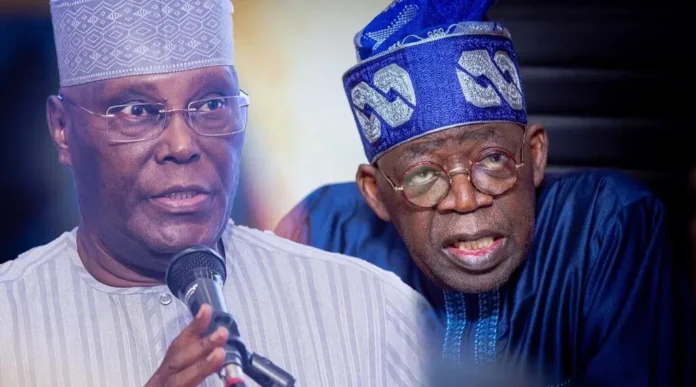
The Presidency has accused former Vice‑President Atiku Abubakar of repeatedly changing his position on petrol subsidy, describing his latest intervention as the third policy somersault within one week.
Special Adviser to the President on Information and Strategy, Bayo Onanuga, issued a statement on Wednesday saying the conflicting positions from Atiku and his aides raised doubts about whether he had a coherent economic plan or was exploiting Nigerians’ concerns over rising living costs.
The Presidency challenged Atiku to explain the cost of his proposed subsidy, its beneficiaries, how it would be funded, and the conditions under which it would be terminated.
The controversy followed a series of statements from Atiku’s team. His spokesperson, Paul Ibe, initially said Atiku would restore the subsidy if elected president and later phase it out, describing the measure as temporary relief for Nigerians and businesses.
Another aide, Phrank Shaibu, dismissed Ibe’s statement as “unauthorised and misleading”.
Shaibu insisted Atiku would not set a fixed date for ending the subsidy, saying it would remain until domestic refining expanded, supply stabilised, competition deepened, and market forces could deliver affordable petrol prices without government support.
Atiku later intervened directly, insisting his position “has not changed” and reaffirming his plan to restore what he called a “targeted subsidy”. “I will restore targeted subsidy and put purchasing power back in the hands of Nigerians,” he said.
Presidency Calls Out Contradictions
Onanuga said the differing explanations amounted to more than a disagreement over wording. “This is not merely a matter of semantics. It is a serious policy contradiction and confusion. Nigerians deserve clarity, not policy by trial and error,” he stated.
He argued that Atiku’s claim that subsidy and competition would automatically reduce petrol prices was flawed, noting that pump prices are influenced by international crude oil prices, exchange rates, refining costs, transportation, distribution, and other market factors.
“Competition can improve efficiency and margins, but it cannot magically insulate Nigeria from global crude oil prices or other input costs,” Onanuga said.
Onanuga also rejected what he described as an oversimplification of the link between petrol prices and food inflation.
While acknowledging that energy and transport costs affect food prices, he said agricultural productivity, insecurity, exchange rates, logistics, storage, flooding, input costs, money supply, and supply constraints also contribute significantly.
“A serious economic programme must address these factors, rather than reduce the entire cost‑of‑living crisis to petrol prices,” he explained.
He added that the Tinubu administration had implemented policies over the past three years to strengthen Nigeria’s fiscal position and stabilise the macroeconomic environment.
Questions on Subsidy Scope
Onanuga pressed Atiku to provide specific details of his proposed targeted subsidy.
“We therefore urge Atiku to stop shifting positions and explain precisely what he means by ‘targeted subsidy’: how much will it cost, who will benefit, how will beneficiaries be identified, how will it be funded, and what objective economic conditions will determine its eventual termination?” he asked.
He warned against replacing the previous subsidy arrangement with another costly and opaque regime under a different name.
Onanuga also questioned Atiku’s suggestion that subsidy would “follow the barrel of crude”, pointing out that petrol represents only one of several products obtained from refining crude oil.
He explained that petrol accounts for about 45% of products from a barrel, diesel roughly 25%, aviation fuel and kerosene about 9%, with the remainder consisting of other petroleum products.
“Will Atiku subsidise all these by‑products of the barrel as well, since kerosene is used by the underprivileged to cook, and many homes and factories use diesel to power generators and delivery trucks?” he asked.
He further questioned whether refineries supplied with discounted crude would be allowed to profit from other refined products while government support was restricted to petrol.
“Will he allow the refineries he will supply discounted crude oil to profit from 55% of the by‑products, while focusing subsidy only on petrol, his obsession?” Onanuga asked.
Concluding, he said: “The economy is too serious for policy somersaults, incoherence, destructive populism and election gimmicks.”

 WhatsApp Channel
 Telegram Channel