





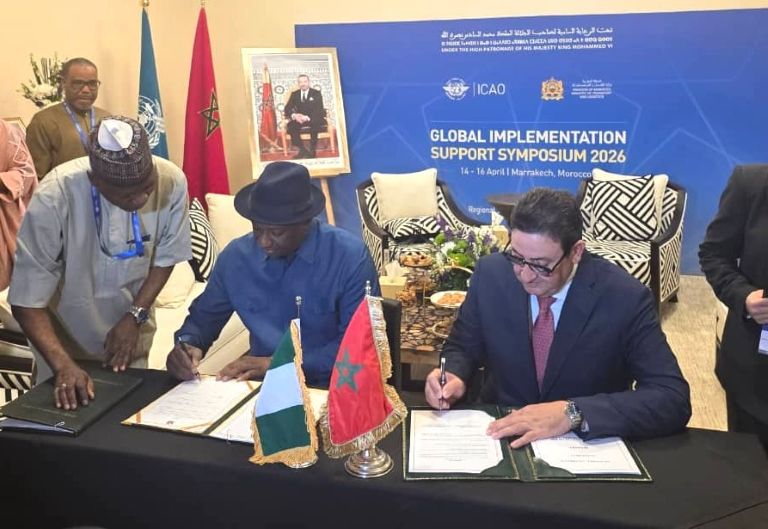
Nigeria’s Minister of Aviation and Aerospace Development, Festus Keyamo, has signed a Reviewed Bilateral Air Services Agreement (BASA) with the Kingdom of Morocco.
The signing took place on Wednesday, April 15, 2026, during the Global Implementation Support Symposium (GISS) in Marrakech, Morocco.
The agreement was part of Keyamo’s high-level engagements with the International Civil Aviation Organisation (ICAO) and the European Union.
It is a significant step in strengthening air transport relations between Nigeria and Morocco.
“It establishes a modern and forward-looking framework that enhances connectivity, deepens commercial cooperation, and expands operational opportunities for airlines, airports, and regulatory institutions,” Keyamo said in a statement issued by his Special Adviser on Media and Communications, Tunde Moshood.
Specific Gains of BASA with Morocco
Here are some specific benefits to Nigeria from the Nigeria-Morocco BASA.
1. Direct air connectivity
- New routes: The agreement enables direct flights between Nigeria and Morocco, ending the need for layovers in Europe. This cuts travel time and cost for business, tourism, and the Nigerian diaspora in North Africa.
- More carriers: Both countries’ airlines can operate flights on the route, increasing competition and seat capacity.
2. Trade and investment growth
- Easier business travel: Speaker of Nigeria’s House of Reps Abbas Tajudeen said trade with Morocco could hit $2.5 billion annually if trade barriers are removed. Direct flights make deal-making, site visits, and cargo movement faster.
- Key sectors targeted: Nigeria’s Minister of Industry, Trade & Investment noted current trade revolves around petroleum, agriculture, telecommunications, and financial technology. BASA helps scale these by improving logistics.
- AfCFTA leverage: The Speaker specifically tied BASA to activating the African Continental Free Trade Area (AfCFTA) between both countries, letting Nigerian firms export to Morocco with fewer hurdles.
3. Economic diversification for Nigeria
- Beyond oil: The House of Reps said its legislative strategy is to reduce oil dependence by growing mineral mining, manufacturing, agro-processing, textiles, tourism, tech services. Direct air links support all of these by moving people and high-value cargo.
- Tourism boost: Morocco is a major tourist hub. Direct flights make Nigeria a more accessible market for Moroccan tourists and vice versa.
4. Aviation sector gains
- Nigerian carriers benefit: Local airlines like Air Peace or United Nigeria can expand into North Africa, earning forex and creating jobs.
- Cargo opportunities: Nigeria’s agricultural and manufacturing exports get faster air freight access to Morocco and onward to Europe.
5. Strategic positioning
- South-South ties: The Nigeria-Brazil BASA was framed as strengthening “South-South diplomatic and economic ties”. Same logic applies to Morocco — Nigeria positions itself as West Africa’s aviation hub linking to North Africa.
- Part of broader push: BASA was signed alongside agreements to remove double taxation and create direct sea lanes, showing a coordinated push to deepen Nigeria-Morocco economic integration.
ICAO Commits to Nigeria’s Aviation Growth
On the opening day of the symposium, Keyamo paid a courtesy visit to ICAO Council President Toshiyuki Onuma. During the meeting, Onuma reaffirmed ICAO’s commitment to deepening cooperation with Nigeria.
“Nigeria’s Civil Aviation Masterplan demonstrates a comprehensive vision for the sector,” Onuma said, commending the country’s progress. He also praised Keyamo’s presentation on “The Future of Aviation’s Workforce.”
Onuma pledged enhanced support for Nigeria in aviation workforce development, capacity building, and strategic programme implementation.
In response, Keyamo reiterated Nigeria’s alignment with ICAO’s global standards and long-term vision for a safe, secure, and sustainable aviation sector.
EU Engagement and Wider Impact
On the sidelines of the symposium, Keyamo held discussions with the European Union delegation. Both parties explored expanded opportunities for technical assistance, safety oversight, and institutional collaboration.
“Beyond aviation, the agreement is expected to catalyze broader economic growth by opening new channels for trade, tourism, investment, and people-to-people exchanges between Nigeria and Morocco,” Keyamo stated.
The BASA also aligns with continental aviation priorities, supports environmental sustainability, and reinforces shared commitments to safety and operational efficiency.
The agreement supports Nigeria’s determination to modernise its aviation sector in line with global best practices.
Nigeria’s aviation sector has long sought stronger international partnerships to boost connectivity and competitiveness. This agreement may help it position itself as a key player in Africa’s aviation future.

 WhatsApp Channel
 Telegram Channel