


Former Finance Minister Kemi Adeosun peels back the layers of “Trump’s War,” moving past oil price headlines to reveal a quieter, deadlier crisis: the threat to Nigeria’s dinner tables. By tracing the path from the Strait of Hormuz to the village farm, she explains how global conflict dictates the cost of fertilizer today and the harvest of tomorrow.
I am, at my core, a village girl. I say this with a whole lot of pride.
Both of my parents made the journey that defined a generation of Nigerians: out of their respective villages in what was then the Western Region, now Ogun Waterside LGA. A few years in Lagos, then a trip to London that was supposed to be temporary and quietly became a life — but never severed our village connections. What matters here is what it means to carry the village with you.
To understand that when we talk about commodity markets, fertilizer prices, and the Strait of Hormuz, we are, at some remove, talking about a woman on her way to a farm at five in the morning. We are talking about my people.
So as I try to make sense of Trump’s War — the US-Israeli strikes on Iran that began in late February, and the conflict that has since reshaped global markets with alarming speed — I find myself doing what I always do. I bring it home. Not to Lagos. Not to Abuja. To the village.
And what I find there is not the story anyone is telling.
The Familiar Hope
The thing most Nigerians noticed about this war was the oil price. I addressed that in an earlier piece in this series — the argument that every spike in crude is a national salvation is one Nigeria has never quite outgrown, and one I believe deserves more scepticism than it usually receives.
This time, my concern runs through a different pipe.
The Strait Does More Than One Job
Everyone is watching the Strait of Hormuz as an oil chokepoint. That framing is accurate but incomplete. The same narrow corridor that carries a fifth of the world’s oil also carries roughly a third of globally traded fertilizer. The natural gas transiting it is not only fuel — it is the primary feedstock for synthetic nitrogen fertilizer. Urea, the world’s most widely used nitrogen product, is manufactured from natural gas. Disrupt the gas, and you disrupt, with a lag of weeks and then months, the harvest.
“The abstraction of geopolitics meets the concreteness of an empty fertilizer bag on a dirt floor.”
This is no longer a theoretical risk. Qatar shut down the world’s largest urea facility after its LNG infrastructure was targeted. Since then, India has cut output from three of its own urea plants. Bangladesh has shuttered four of its five fertilizer factories. Urea export prices from the Middle East surged roughly 40 percent in days. The numbers in the table below tell the rest of that story more efficiently than I can.
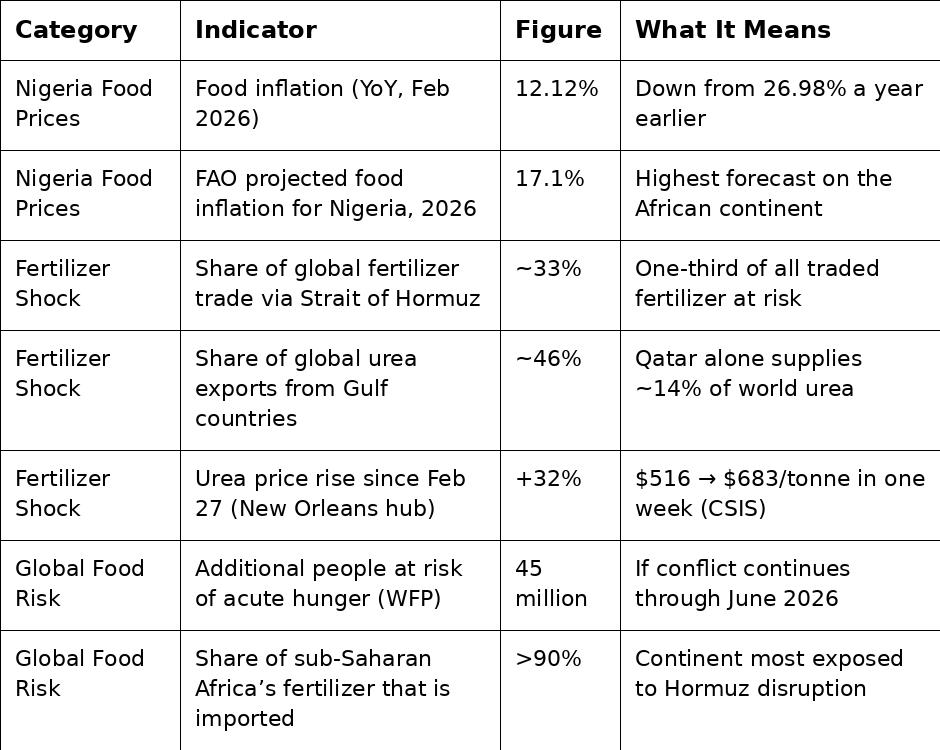
Here is what the timing means practically: planting season in Nigeria’s food belt is now. March and April are when the farmer in Osun, Kano, Benue, and my village makes the input decisions that determine what will be on the table in October. The fertilizer she buys this month, at whatever price the market has set, is the harvest she will bring in at year’s end. There is no revision. There is no second quarter. The decisions being made right now, against a backdrop of global price spikes and supply uncertainty, will be felt at the dinner table long after the headlines have moved on.
The Village Arithmetic
Roughly 70 percent of Nigeria’s agricultural workforce operates at smallholder scale: small plots, limited capital, no price hedging, and no buffer when input costs move sharply upward. My village farmer does not use pure urea. She uses the NPK blend — nitrogen, phosphorus, and potassium — calibrated to maize, cassava, and the staples that fill the household pot. Nigeria is, in the nitrogen column, a genuine exporter. But the phosphorus and potassium in that blend are imported, passing through the same Strait of Hormuz now effectively closed to shipping.
“Petrol prices change overnight—everyone sees an energy shock. Fertilizer shocks are slower and quieter. Crop yields reveal themselves months later.”
When fertilizer becomes expensive or scarce, the smallholder faces a choice that is no choice at all: pay more and squeeze everything else, buy less and accept lower yields, or plant less and eat less. All three options have the same destination. The empty table.
Nigeria was making progress. Food inflation fell to 8.89 percent in January — the first single-digit reading in over a decade. Eleven consecutive months of declining headline inflation. The CBN’s cautious cutting cycle was finally beginning to offer some relief to an SME sector crushed by the cost of credit. None of that work has been undone yet. But it is now exposed to a global shock that carries no mechanism to compensate the countries least responsible for it.
The Cruellest Part of the Arithmetic
The oil revenue and the food price increase are not offsetting entries in the same household budget. They hit entirely different people through entirely different channels.
Oil revenue, when and if it arrives, flows through the federation account to the three tiers of government — salaries, capital projects, ministerial budgets. Its benefits, such as they are, travel through a long chain of institutions before reaching households.
The food price increase arrives at the market stall this week. At the roadside food vendor this morning. At the woman carrying a basket on her head who has just been told that the bag of fertilizer now costs 40 percent more than it did in January. One goes up for the government. The other goes up for the household. They do not cancel each other out.
There is also a timing problem that rarely appears in the commodity analysis. Petrol prices change overnight — everyone sees an energy shock. Fertilizer shocks are slower and quieter. Crop yields reveal themselves months later. The cost of a missed planting decision will not appear in the food price index until harvest time, by which point it cannot be undone and the headlines will have moved elsewhere.
A War Nobody Voted For
There is something disorienting about explaining to a smallholder farmer in Nigeria’s food belt why her input costs have increased because of airstrikes she did not authorise, on a country she has never visited, ordered by a president she did not elect. The abstraction of geopolitics meets the concreteness of an empty fertilizer bag on a dirt floor.
“The oil revenue and the food price increase are not offsetting entries in the same household budget. One goes up for the government. The other goes up for the household.”
This is the part of economics I return to again and again. The commodity price charts, the shipping route analyses, the constraint indices — they are all real, all useful. But they stop at the level of the market and never quite reach the level of the person. My training insists I speak the language of the chart. My village insists I remember whose life the chart is describing.
What Trump’s War costs my village is not abstractions. It is higher prices arriving precisely at the moment when the farmer must decide what to plant and how much to spend on making it grow. It is the accumulated cost of a global shock that has no mechanism to compensate the people least responsible for it.
The war is a long way from there. But its consequences are not.
The opinions expressed in this article are strictly those of the author and do not necessarily align with the views of JolibaLive News! or any of its staff members. The author is in no way associated with this online news blog. The author, Kemi Adeosun is a former Minister of Finance of the Federal Republic of Nigeria and former Commissioner for Finance of Ogun State. She champions small business with Nidacity.com and writes from Lagos.
Rate, Like 👍, Comment 💬, Share this article, Follow us on our social media handles, and Submit your own story to get featured and earn rewards!
 WhatsApp Channel
 Telegram Channel