



A United States District Court has sentenced James Junior Aliyu, a Nigerian national, to 90 months (seven and a half years) in federal prison.
The sentence follows his leading role in a sophisticated $4.1 million Business Email Compromise (BEC) and money laundering conspiracy.
The U.S. Immigration and Customs Enforcement (ICE) confirmed the sentencing on Saturday, March 21, 2026. Aliyu, who was extradited from South Africa to face justice, is the final defendant among a trio of conspirators to be sentenced in this high-profile case.
According to court documents, between February and July 2017, Aliyu and his co-conspirators—including Kosi Goodness Simon-Ebo and Henry Onyedikachi Echefu—orchestrated a complex hacking operation.
The group targeted businesses and individuals by gaining unauthorized access to their email servers.
Using “spoofed” email addresses designed to look like legitimate business partners, the criminals sent forged wiring instructions to their victims.
These instructions redirected massive payments into “drop accounts” controlled by the syndicate.
Investigations revealed that the group’s intended losses exceeded $4.1 million. While they successfully made off with at least $1.5 million, Aliyu was found to have personally controlled nearly $1.2 million of the stolen funds.
Financial Consequences and Deportation
The court was not lenient regarding the financial damage caused. In addition to his prison term, Aliyu has been hit with a $1.2 million forfeiture order and must pay $2.4 million in restitution to his victims.
“James Junior Aliyu will serve a 90-month sentence for his role in a wire fraud and money laundering conspiracy after planning to hack business email servers,” the ICE statement read.
The authorities also made it 100% clear that Aliyu’s time in the U.S. will end the moment his prison term does; he faces immediate deportation back to Nigeria upon his release.
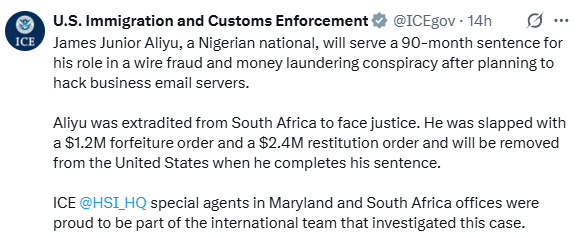
The conviction marks a significant win for international law enforcement. The case involved a multi-year effort by ICE Homeland Security Investigations (HSI) agents in both Maryland and South Africa.
Aliyu and his partners believed that operating from South Africa provided a layer of protection, but their extradition in 2022 proved otherwise.
Eight other defendants related to the broader conspiracy had previously pleaded guilty, signaling a total collapse of the network.
To hide their tracks, the group laundered the money through cashier’s checks, cash withdrawals, and complex account transfers.
However, digital breadcrumbs left by the “spoofed” emails eventually led investigators directly to Aliyu.
This news should matter to you because BEC scams remain one of the most financially damaging categories of cybercrime globally. It serves as a stern reminder that international borders are no longer a shield for those targeting the U.S. financial system.
Rate, Like 👍, Comment 💬, Share this article, Follow us on our social media handles, and Submit your own story to get featured and earn rewards!





One ought to be mindful with US government, because once they said, they meant.
And most victims of their offenses are likely Nigerians.
I strongly believe that mandatory deportation after prison is a strong enough deterrent to stop international wire fraud, because the white maintain their law, no bribe onlike Nigeria does, coupled with the President Bola Ahmed Tinubu’s visit at UK had already said it all.