
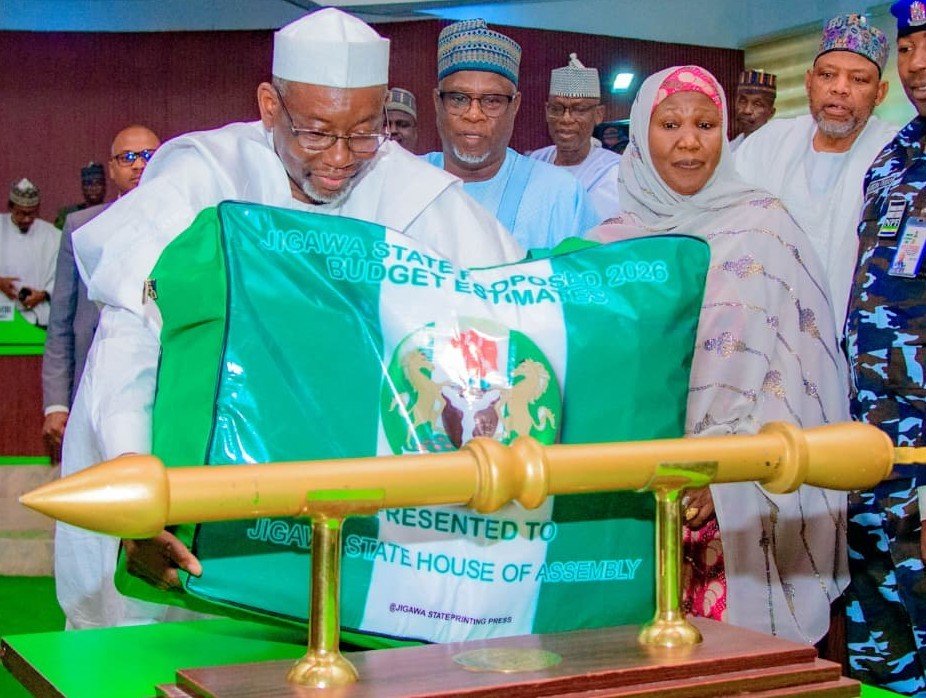
The Jigawa State House of Assembly has unanimously approved a ₦901.84 billion budget for the 2026 fiscal year, endorsing Governor Umar Namadi’s proposal tagged the “Budget of Innovation and Transformation for Greater Jigawa II.”
Presented on November 25, 2025, the budget places strong emphasis on development‑driven spending, with nearly 77 percent allocated to capital projects.
Education alone accounts for more than 26 percent, while agriculture and healthcare also receive significant funding.
Speaker Aliyu Dangyatim, announcing the passage during plenary, said the budget was approved exactly as presented by the governor, without amendments.
He disclosed that ₦693.4 billion is earmarked for capital expenditure, targeting roads, energy, agriculture, education infrastructure, and healthcare.
The 2026 budget represents a 19.2 percent increase over the 2025 fiscal plan, which Dangyatim described as evidence of the state government’s commitment to rapid growth and innovation.
Heavy Investment in Education and Agriculture
Chairman of the House Committee on Appropriation, Ibrahim Hamza Adamu, described the budget as people‑focused and development‑oriented.
He revealed that ₦75 billion has been allocated to food and livestock production, aimed at boosting food security, commercial farming, and job creation across the state.
Adamu stressed that the heavy investment in education is designed to improve learning infrastructure and quality, noting that education remains central to Jigawa’s long‑term development strategy.
The allocation, he claims, is to strengthen human capital, as northern states grapple with challenges of literacy, youth unemployment, and underfunded schools.
The passage of the budget underscores Jigawa’s ambition to align state priorities with Nigeria’s national development goals.
By directing the bulk of spending toward infrastructure, agriculture, and education, the government hopes to stimulate economic expansion, reduce poverty, and improve social services.
With food security and education at the heart of the plan, the 2026 budget is positioned as both a growth strategy and a social investment.
If delivered as planned, the budget could accelerate road construction, expand energy access, modernise schools, and improve healthcare delivery — all critical to raising living standards in one of Nigeria’s less industrialised states.
Rate, Like 👍, Comment 💬, Share this article, Follow us on our social media handles, and Submit your own story to get featured and earn rewards!
 WhatsApp Channel
 Telegram Channel