


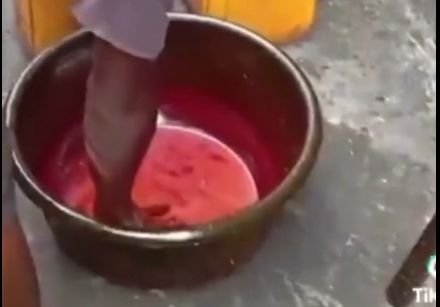
A viral video showing a man mixing palm oil with concentrated dye has triggered outrage across Nigeria, with health experts and consumers demanding urgent intervention from the National Agency for Food and Drug Administration and Control (NAFDAC).
The footage, which surfaced in late November, shows the individual pouring dye into a large container of palm oil to intensify its red colour.
Medical professionals warn the practice could cause cancer. Popular health influencer and doctor Chinonso Egemba, known as Aproko Doctor, condemned the act.
“This is wickedness. What do you mean you’re putting dye inside palm oil just so that it will look red? And then you’re selling it to people, knowing that what people are actually drinking or putting in their food is not actual palm oil but something mixed with dye,” he said.
He added: “There are certain dyes that are actually carcinogenic, which can actually lead to cancer in some people. So, when you hear things like our life expectancy in Nigeria is 50‑something years old, these are part of the reasons.”
Dr Yonni Johnson, tweeting as #CoddasO, echoed the concerns: “Adding dye to palm oil is not ‘business,’ it is slow murder. Many of these dyes are carcinogenic, damaging the liver, kidneys, blood and increasing long‑term cancer risk.”
Weak Regulation and DIY Tests
Egemba criticised weak regulation in Nigeria’s informal market.
“This particular person is probably not registered. Their products are entering the market in a way that is unregulated. Local officers who are supposed to be hunting down this type of person are probably underfunded. Most times, they’ve gone to find another work rather than actually ensuring our health as Nigerians,” he said.
He also demonstrated a home test for adulterated oil, showing that pure palm oil separates cleanly from water, while dyed oil leaches colour. “We should not be doing mathematics to cook food,” he lamented.
Some users cautioned that the DIY method may not be conclusive. One noted that lipophilic azo dyes dissolve in oil but not in water, making detection harder.
Reactions online suggest that consumer demand for intensely red palm oil often drives vendors to adulterate the product.
Genuine palm oil derives its natural red hue from carotenoids, not chemicals.
Rate, Like 👍, Comment 💬, Share this article, Follow us on our social media handles, and Submit your own story to get featured and earn rewards!
 WhatsApp Channel
 Telegram Channel