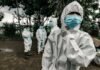




Nigeria’s Ebola response widened sharply this week as new details about the confirmed patient’s travel history, her worsening condition and a coordinated multi-agency clampdown emerged.
The Federal Capital Territory (FCT) case, first confirmed on Tuesday, October 20, 2026, has since drawn reactions from the National Assembly, the Aviation Ministry, opposition politicians and several state governments.
Health officials say the patient is a diplomat whose identity and nationality have not been disclosed, and whose condition has reportedly deteriorated into multi-organ failure.
The virus has been identified as the Bundibugyo strain, the same strain driving a major outbreak in the Democratic Republic of Congo (DRC) that the World Health Organisation (WHO) declared a Public Health Emergency of International Concern on May 16, 2026.
As of October 11, the DRC had recorded over 9,000 confirmed cases and more than 4,300 deaths, making it the second-largest Ebola outbreak in history, with no approved vaccine or specific treatment currently available.
Fresh Details Emerge On The Patient’s Travel And Diagnosis
A highly placed aviation official told Vanguard on condition of anonymity that the patient arrived in Nigeria on October 3, 2026, aboard Ethiopian Airlines Flight ET333, landing at the Nnamdi Azikiwe International Airport, Abuja.
The Nigeria Centre for Disease Control and Prevention (NCDC), however, said the woman arrived from Uganda on October 5, developed symptoms on October 7, and sought treatment at a private hospital on October 11 after failing to respond to malaria treatment.
“The patient’s condition has deteriorated. We did three levels of tests, but all were molecular. The strain was Bundibugyo,” said Olajumoke Babatunde, Director of the Public Health Laboratory Service at the NCDC.
The patient was later transferred to a designated isolation facility, where she remains under treatment.
Uganda Denies Local Transmission, Demands Full Records From Nigeria
The Ugandan government has asked Nigeria to provide detailed travel and clinical records of the patient, insisting she did not contract the virus within its territory.
In a statement titled “Reported Ebola Case in Nigeria: Ministry Calls for Calm and Vigilance,” Uganda’s Director-General of Health Services, Prof. Charles Olaro, said the woman had travelled to eastern DRC for business and transited through Uganda in early October without showing symptoms.
“Her transit through Uganda does not establish that she contracted the infection there. The location of exposure remains under investigation,” the statement read.
Uganda was officially declared Ebola-free by the WHO in August 2026, after recording 20 cases, almost all linked to travellers from the DRC.
FG Says It Is Collaborating With Uganda To Contain The Outbreak
The Coordinating Minister of Health and Social Welfare, Prof. Muhammad Ali Pate, said the Federal Government is working with Uganda to trace the patient’s contacts and stop further spread.
“All I can tell you is that we are collaborating with our sister African nation of Uganda. What is important is that we have found this one case. We are doing contact tracing, and we are putting containment measures to ensure that it doesn’t go into our population,” Pate said.
He said Nigeria had successfully managed Ebola before, pointing to the country’s 2014 response.
Pate also confirmed that President Bola Tinubu directed a review of Nigeria’s Ebola response plan at a National Security Council meeting on October 15, 2026, adding that coordination with the Office of the National Security Adviser had “served us well.”
National Assembly Demands Mandatory Screening And Fund Release
The Senate and House of Representatives have both called on the Federal Government to make health screening compulsory for all arriving passengers at every international airport, seaport and land border.
A motion sponsored by Senator Francis Faduyile (APC, Ondo South) warned that the NCDC had rated the risk of Ebola importation as high and recalled Nigeria’s 2014 outbreak, which recorded 20 cases and eight deaths.
Senate President Godswill Akpabio described Ebola as a serious medical emergency, saying, “We have to be proactive; everybody must take part. If it spreads, it will be a major problem.”
The Senate also called for the modernisation of the Quarantine Act of 1926, Nigeria’s primary legal framework for preventing the spread of dangerous infectious diseases, to align it with the WHO’s International Health Regulations.
In the House, lawmakers adopted a motion by Amobi Ogah demanding the immediate release of outstanding appropriated funds to relevant health agencies for surveillance, contact tracing and laboratory testing.
Atiku Demands Account Of ₦10bn Ebola Preparedness Fund
Former Vice President Atiku Abubakar challenged President Tinubu to account for the ₦10 billion earlier approved for Ebola preparedness, alleging the Abuja case exposed gaps in surveillance and protection for health workers.
In a statement by Phrank Shaibu, Director of Strategic Communication of the ADC Presidential Campaign Council, Atiku demanded a public audit of the funds.
“Where is the money? Publish the amount actually disbursed, the dates of payment, every contract awarded, every recipient and every item delivered. A press statement cannot replace an audit,” he said.
Atiku alleged that 44 close contacts went unmonitored between the patient’s hospital visit on October 11 and the government’s public confirmation on October 20.
Aviation Sector And States Step Up Surveillance
The Minister of Aviation and Aerospace Development, Festus Keyamo, directed the Nigeria Civil Aviation Authority to place 46 contacts, including 44 hospital contacts and two domestic staff, on a no-fly list for 21 days.
“The Aviation authorities are required to put them on a no-fly list for at least 21 days,” Keyamo said, explaining that the period matches the time within which symptoms typically appear.
The Federal Airports Authority of Nigeria has also begun installing temperature-screening cameras at airports, alongside enhanced health declarations and staff protective equipment.
Several states, including Anambra, Niger, Ogun, Yobe, Enugu and Kano, have activated emergency operations centres, isolation facilities and contact-tracing teams, while the Kaduna chapter of the Association of Medical Laboratory Scientists of Nigeria (AMLSN) has asked political parties to shift campaigns online to limit physical contact ahead of 2027.
The NCDC said its Incident Action Plan was being finalised, with teams already on the ground prioritising enhanced surveillance, infection prevention and risk communication to protect Nigerians.