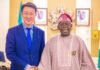




The United States has withdrawn most of its military personnel from Nigeria after completing a months-long counterterrorism mission in the Lake Chad Basin.
About 200 American troops were sent to Nigeria in February 2026 to support Nigerian forces with intelligence, surveillance, reconnaissance and specialised training against ISWAP and other armed groups in the region.
Commander of US Air Forces in Africa, General Dagvin R.M. Anderson, said the deployment achieved its immediate goals and most of the troops had returned home.
“And so that operation in the Lake Chad Basin of Nigeria not only helped the countries in that immediate region; it also helps countries globally as that disrupts the ISIS network.”
He said the mission also helped disrupt wider Islamic State networks beyond West Africa.
“And so — and then we have withdrawn much of our forces that were just there for that operation, but are continuing the partnership that Nigeria has asked for to help continue with the intelligence sharing and the understanding that’s necessary to be able to prosecute these difficult tasks.”
Anderson said the US and Nigeria had worked closely during the operation, combining Nigerian military strength with American intelligence and technical support.
Partnership Continues
He praised Nigeria’s size, economy, population and military capacity, saying the country remains an important security partner for Washington.
“I think the partnership that we’ve shown recently with Nigeria, where Nigeria’s a very capable and large country — it’s got a strong economy; it’s got a large, educated population; it’s got a very capable military.”
He added that the collaboration made it possible to share intelligence in ways that improved the fight against extremist groups.
“But there are things that we have learned in the counterterrorist fight over several years that we were able to assist and integrate with them to help them with their intelligence and help with the intelligence sharing that eventually led to a cooperative effort to where we were able to bring some unique capabilities that the U.S. brings and be able to prosecute together the number two leader within the ISIS or Daesh organization who is responsible for much of their global operations, their global media, and their recruiting.”
Anderson said that kind of cooperation is the model the US wants to keep using, where it brings only the capabilities a partner needs.
“So I think as we go forward, that is an example of how we’re looking at engaging with partners to help them be more effective by only bringing unique U.S. capabilities that allow the partner to be effective in these fights.”
The withdrawal comes after years of insecurity in the Lake Chad Basin, where Boko Haram splinter groups and ISWAP have continued to threaten civilians and soldiers across Nigeria, Chad, Cameroon and Niger.
 WhatsApp Channel
 Telegram Channel