

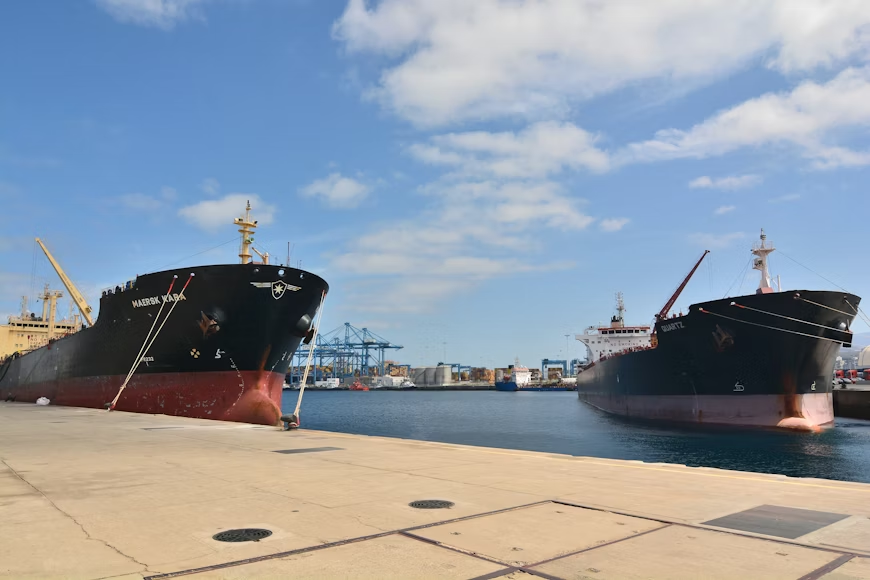
Nigeria’s maritime sector has recorded a sharp revenue rise, with earnings climbing from ₦700bn in 2023 to ₦1.83tn in 2025, as the Federal Government credits policy shifts and tighter oversight.
The Minister of Marine and Blue Economy, Adegboyega Oyetola, disclosed this on Thursday in Abuja during the Blue Economy Investment Summit.
“In 2023, when I assumed office, agencies under the ministry generated about ₦700.79bn.”
“By the end of 2025, this rose to about ₦1.83tn.”
“This remarkable improvement reflects enhanced efficiency, transparency and improved regulatory structure.”
The summit, hosted by Maritime Innovations Hub in collaboration with the ministry, drew investors and operators.
Meanwhile, the minister linked the revenue jump to automation and stricter enforcement across maritime agencies.
“We have restored safety and predictability to our maritime domain.”
“These achievements are not accidental but the result of deliberate reforms.”
Security Gains And Port Reforms Drive Growth
Oyetola said Nigeria has recorded zero piracy incidents for over four years under the Deep Blue Programme.
Furthermore, he confirmed that Apapa port gridlock, which persisted for decades, has now been cleared.
“We have regained our place on the global maritime stage.”
“This has led to renewed international confidence in our governance and performance.”
In addition, the government has secured $746m to modernise Apapa and Tin Can Island ports.
Implementation, he said, will begin this quarter to improve capacity and efficiency.
“This policy has become our tool for action.”
The minister referred to a newly launched marine and blue economy policy designed to guide long-term investment.
According to APM Terminals Nigeria CEO Frederik Klinke, global shipping disruptions are raising freight costs.
“Geopolitical tensions are increasing uncertainty in international trade.”
However, he acknowledged Nigeria’s progress, citing reforms like the National Single Window platform.
“Cargo clearance time is expected to drop to 48 hours.”
Investment Push Expands Maritime Opportunities
Oyetola said the sector now offers opportunities across fisheries, logistics, and port infrastructure.
“There are substantial investment opportunities across the entire value chain.”
“We have designed an attractive platform for private sector participation and job creation.”
Klinke added that APM Terminals has invested over $600m in Nigeria, including automation and renewable energy.
“Export volumes have risen due to improved efficiency.”
Meanwhile, Pius Akutah of the Nigerian Shippers’ Council warned that weak connectivity still limits trade.
“Maritime connectivity remains a major obstacle to AfCFTA implementation.”
Earlier, Ronke Kosoko of the Maritime Innovation Hub said the summit connects investors to opportunities.
“Technology has expanded participation beyond physical attendance.”
As Nigeria pushes its blue economy agenda, the maritime sector is emerging as a key revenue source beyond oil.
Rate, Like 👍, Comment 💬, Share this article, Follow us on our social media handles, and Submit your own story to get featured and earn rewards!
 WhatsApp Channel
 Telegram Channel