

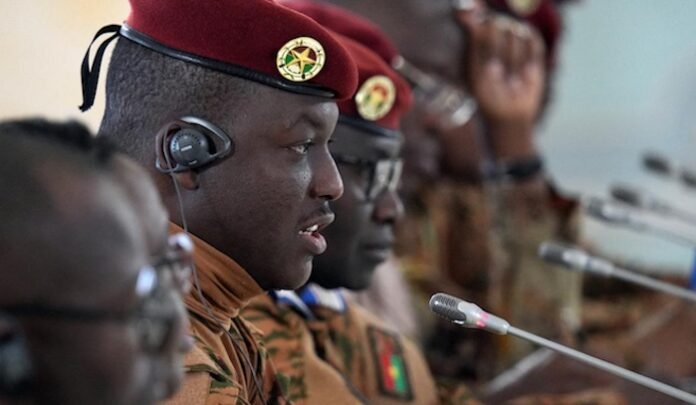
Burkina Faso’s military leader, Ibrahim Traore, has told his citizens to “forget” about democracy, just three months after his government dissolved all political parties.
Speaking during a lengthy state television interview on Thursday, April 2, 2026, Traore alleged that democratic systems are a foreign imposition that leads to bloodshed.
Consequently, the 38-year-old leader, who seized power in a September 2022 coup, has signaled a permanent departure from his initial promises to hold national elections.
Traore referenced the instability in neighboring Libya as a primary reason for his stance, suggesting that outsiders failed when attempting to “impose” Western governance.
“People need to forget about the issue of democracy,” Traore stated during the broadcast. “We have to tell the truth: democracy isn’t for us.”
According to RFI, the leader went further by characterizing the electoral system as a terminal threat to the nation’s survival.
“Democracy kills,” Traore said. “Everywhere they try to establish democracy in the world, it’s done with bloodshed. Democracy is slavery.”
Security Failures And The Dissolution Of State Institutions
Traore initially gained power by overthrowing President Roch Marc Kabore, promising to defeat al-Qaeda and ISIL-linked groups that control large swaths of the country.
However, the security situation has worsened. Analysis from the Africa Center for Strategic Studies shows fatalities tripled to 17,775 by May 2025 under his tenure.
In July 2025, the government dissolved the Independent National Electoral Commission. Traore alleged that the agency was too expensive to maintain during a period of war.
Furthermore, the government scrapped more than 100 political parties in January 2026 and seized their assets to fund military operations.
Meanwhile, Traore has faced intense criticism for the forced conscription of his political opponents, journalists, and prosecutors who are sent to the front lines.
This tactic has become a signature of his administration. Many leaders critical of the military government now remain silent or have fled the country.
Traore has turned to Russian paramilitary fighters after evicting French forces. Previously, France had deployed 5,000 soldiers to help fight armed groups in the Sahel.
The Alliance Of Sahel States And Regional Isolation
Burkina Faso, Niger, and Mali exited the Economic Community of West African States (ECOWAS) last year to form the Alliance of Sahel States (AES).
This move came after significant regional pressure to hold elections. Traore alleged that the country would not vote until every part of the territory is safe.
“Look at Libya, it’s a prime example right next to us,” Traore stated during his TV appearance to justify his rejection of regional democratic standards.
The leader continues to enjoy support from segments of the African diaspora due to his anti-Western rhetoric. However, the internal humanitarian crisis remains severe.
Hundreds of thousands of civilians remain displaced. Furthermore, the military has struggled to regain territory from insurgents despite the influx of new foreign allies.
The suspension of parliament and all political activity suggests that Traore intends to rule indefinitely. Meanwhile, the judiciary remains under significant executive pressure.
The transition to a permanent military state appears nearly complete. The prospects for a return to civilian rule in Ouagadougou have effectively vanished.
So, share your view on this article. Do you believe that African nations should prioritize military stability over democratic processes when facing serious threats from extremist groups?