



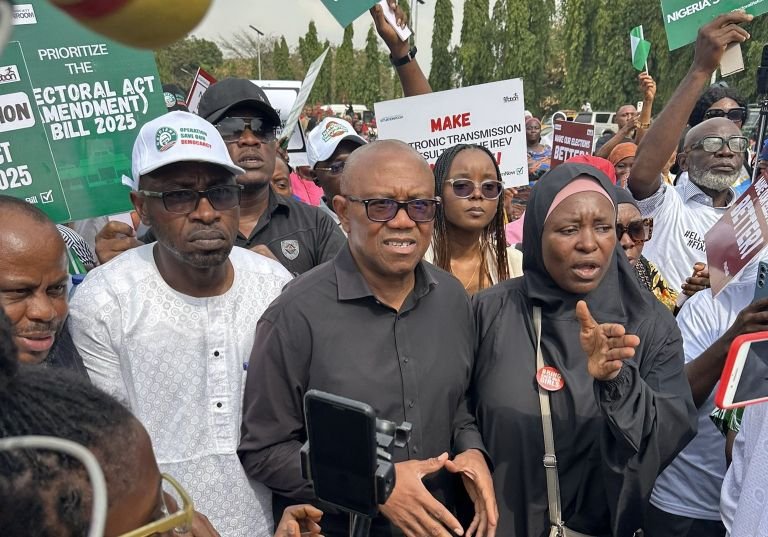
Protesters gathered at the National Assembly Complex in Abuja on Monday, February 9, 2026, demanding that lawmakers make real-time electronic transmission of election results compulsory in the amended Electoral Act.
Under tight security, demonstrators, including grassroots activists and political personalities, pressed for changes to the legislation amid ongoing controversy over the Senate’s handling of voting technology provisions.
The crowd surged toward the main gate of the legislature complex, chanting slogans and holding placards calling for transparency and credibility in Nigeria’s electoral system as they confronted armed officers from the Nigeria Police Force, the Nigerian Army, and the Nigeria Security and Civil Defence Corps.
Tension Over Electronic Transmission Provisions and Calls for Clear Electoral Law
The demonstration came after the Senate’s controversial passage of the Electoral Act 2022 (Repeal and Re-enactment) Amendment Bill 2026, which critics say diluted efforts to enhance the credibility of future polls by dropping a clause that would make electronic transmission of results from polling units to the Independent National Electoral Commission (INEC) mandatory and in real time.
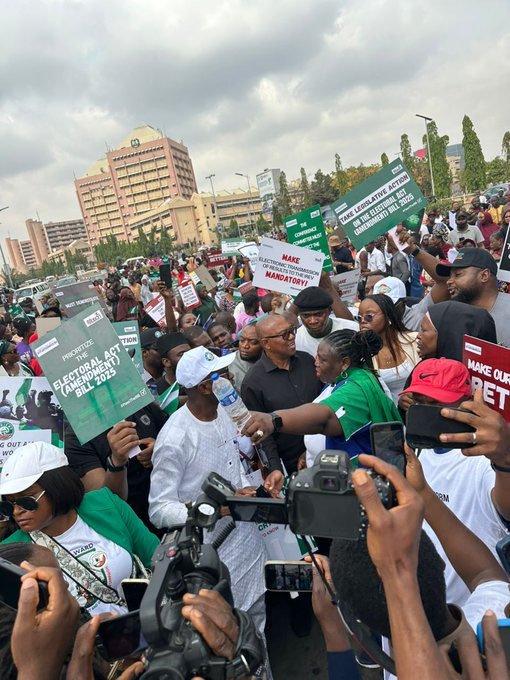
Under the disputed clause, presiding officers at polling units would have been legally required to transmit results electronically to the IReV portal in real time, immediately after ballot forms were signed and stamped by election officials and party agents.
Protesters say removing explicit language on real-time transmission opens the door to ambiguity and continued reliance on manual result collation that has historically been plagued by irregularities.
They argue that this could weaken public trust in election outcomes and give room for manipulation before, during, and after elections—a concern that has intensified ahead of the 2027 general elections.
Supporters of the protest included student groups, civil society organizations, members of the Obidient Movement, and political parties like the African Democratic Congress (ADC).
The Nigerian Labour Congress (NLC) had also warned of mass action or even a boycott of future elections if “real-time electronic transmission” was not clearly enshrined in law, describing the Senate’s stance as confusing and detrimental to democratic integrity.
Peter Obi Joins Protest
Prominent voices in the protest called on the legislature to harmonize the amendments to eliminate ambiguities and provide Nigerians with transparent, technologically robust electoral processes.
"What we want is an electoral process that is transparent from beginning to finish. We cannot continue to shame Africa."
— News Central TV (@NewsCentralTV) February 9, 2026
Speaking at a protest outside the National Assembly, Peter Obi says Nigeria must adopt transparent elections with full disclosure of candidate qualifications. pic.twitter.com/Mhy4Z5OFSx
Former 2023 presidential candidate Peter Obi stood at the forefront of the demonstrators, echoing their demand for reforms and urging lawmakers to give decisive clarity to the law.
Speaking to a group of journalists covering the event, the politician said, "What we want is an electoral process that is transparent from beginning to finish. We cannot continue to shame Africa.”
Security forces maintained a tight perimeter around the complex to prevent the protest from escalating into violence, though tensions remained high as crowds urged lawmakers to reconsider their position on electronic results transmission.
Despite Senate statements claiming that e-transmission was not rejected outright, protesters insist that the law must explicitly state “real-time electronic transmission” to prevent future disputes and build public confidence.
The Senate has scheduled an emergency plenary session for Tuesday, February 10, where lawmakers may revisit the contentious provisions in response to public pressure.
Do you support the mandatory electronic transmission of result from the polling units to the IReV, or should it be discretionary for INEC given the potential technical and logistical challenges? Will the National Assembly bow to demands and strengthen transparency in Nigeria’s elections? Can “real-time electronic transmission” bring the credibility many Nigerians say they want—or is this protest one of those that will soon fade away into distant memory?
Rate, Like 👍, Comment 💬, Share this article, Follow us on our social media handles, and Submit your own story to get featured and earn rewards!
 WhatsApp Channel
 Telegram Channel






It is clear even to a blind man, that if results are translated in real time. That is, everybody has access and viewership of them, electoral malpractice is reduced by 50%. I say 50% because even real time results doesn’t fully eradicate malpractice. These days we have tools and resources to change it.