

Nigeria’s long encounter with military rule offers sobering lessons about governance, power, and unintended consequences. From benevolent beginnings to brutal excesses, coups repeatedly derailed democratic growth, economic stability, and social trust, leaving scars that still define the nation’s political landscape. As calls for military intervention resurface, this piece argues that only accountable democracy—not jackboots—can rescue Nigeria from its deepening contradictions.
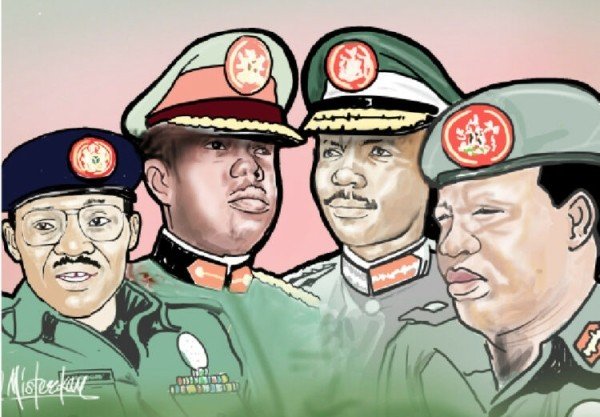
Talking about coups, the most benevolent military regime that ever ruled Nigeria was the one led by General Yakubu Gowon, while the most principled was led by his successor, General Murtala Muhammed, who committed billions of dollars and other logistical requirements towards the liberation struggle in Southern Africa.
Easily the most bestial of all was the General Abacha-led government, which chastised fellow citizens with scorpions while ferreting the commonwealth into his foreign bank accounts.
General Ibrahim Babangida came, dribbled everyone—including himself—and chickened out. All the hopes nursed by Nigerians at the overthrow of his predecessor, the unbending General Buhari, came to nought with the cancellation of the June 12, 1993, elections.
The last of them all, General Abdulsalami Abubakar, who handed over the hot potato to civilians, was a gatekeeper who knew the difference between dusk and dawn.
Governance and the Limits of the Gun
If there is anything Nigerians ought to have learnt from military coups, it is this: soldiers are not trained to govern. Overall, they do more harm than good.
The major difference between avaricious politicians and soldiers who gun their way to power is the costume and accoutrements associated with either party.
Unless you have a revolution that completely routs the old order and installs a new way of doing things—especially if it topples the dog-eat-dog economic arrangement—you will only end up with a khaki-wearing enforcer.
If the foiled coup allegedly slated for October 2025 in Nigeria had been carried out, it would have taken the country back to 1966.
A coup led by a ‘Northern’ Nigerian soldier—with 33 out of the 35 conspirators from his part of the country, supported by a few elements from the South—against a president of southwest extraction would be tantamount to “June 12 on steroids.”
“Soldiers are not trained to govern.”
Those of us who were involved in various ways in that struggle know that it is just an inch away from a voluntary dismantling of Nigeria.
If soldiers did their homework carefully, they would realise that coups are not worth the trouble anymore. Every society has the right to determine how it wishes to be governed.
The social milieu that tolerated “I, Brigadier Sani Abacha, on behalf of the Armed Forces of Nigeria…” has changed drastically now.
In addition, Nigerians are yet to fully recover from the ravages of the civil war.
Lessons from Togo
A good example of how a coup can stunt the development of a country can be found in nearby Togo.
In 1963, President Olympio was resolute about quickly paying off whatever debt his country owed France so that the colonialists could take their noses out of Togo’s business. France and the US could not tolerate that.
So, they arranged a coup led by Sergeant Étienne Eyadéma (later Gnassingbé Eyadéma), Emmanuel Bodjollé, and Kléber Dadjo.
President Olympio was killed right in front of the US embassy in Lomé.
Exiled opposition leaders Nicolas Grunitzky and Antoine Meatchi were then brought in to form a new government.
Grunitzky was president from January 16, 1963, to January 13, 1967. Meatchi was his vice president.
By January 13, 1967, the former sergeant Eyadéma, now a general, pulled the rug from under the feet of Grunitzky and installed himself as president.
He ruled till 2005, when he dropped dead on the job and was succeeded by his son.
For the past 59 years, Togo has laboured under the yoke of the Eyadéma dynasty.
Economic Damage and Militarised Policy Choices
In Nigeria, all the giant strides achieved during the First Republic were cancelled out by the military, which outsourced the running of the economy to global capitalist financial organisations.
When General Babangida was advised by the IMF to introduce the ill-fated Structural Adjustment Programme (SAP) in Nigeria, the people rose against the idea.
But the man Nigerians called Maradona went ahead with the programme nevertheless.
Since then, everything has been serially devalued to the extent that common food items like a crate of eggs, which used to sell for ₦25 in 1990, now cost ₦6000.
“A military coup may look glamorous in fiction, but in real life, it is sorrow, tears and blood.”
Before Babangida, General Obasanjo had tampered with the running of tertiary education by introducing fees and increasing boarding expenses, thereby reducing access to tertiary education.
Little wonder that the most memorable roforofo of the Obasanjo years was the “Ali-Must-Go” protest launched nationwide by the National Union of Nigerian Students (NUNS).
Unitarism and the Long Shadow of 1966
Each military head of state was popular or notorious for a major event or intervention.
For General Ironsi, it was the Unification Decree No. 34 of May 24, 1966, which abolished federalism and introduced a unitary system of government.
This decree also abolished regions. Nigeria is yet to recover from that ill-advised ‘unitarisation’ of our incredibly diverse polity.
Gowon led the federal side in a fratricidal war.
Murtala did not live long enough to generate as much analytical material as an analyst would want, but he did leave enviable footprints in the sands of African liberation struggles.
Obasanjo had the honour of handing over power to a civilian administration led by Alhaji Shehu Shagari, who was toppled on December 31, 1983, after a massively rigged ‘landslide’ election.
General Danjuma had prophetically warned, “Hope this landslide will not lead to a moonslide!”
Democracy, Terrorism, and Unintended Consequences
Now, we have the advantage of hindsight. We know where the rain beat us in 1966. We cannot afford to go back there.
A military coup may look glamorous in the never-never world of fiction, but in real life, it is “sorrow, tears and blood,” as described by the inimitable father of Afrobeat, Fela Anikulapo-Kuti.
My generation had many dreams for Nigeria, but our productive ‘a luta’ years were eaten by the military.
We now look back wistfully at what could have been.
We thought Shagari was an incompetent president until we learnt the true spelling of horror under successive military regimes.
After encountering the military, many former student leaders and activists of the 70s confessed that they owed Alhaji Shagari an apology.
As our elders say, if a woman does not experience two husbands, she would not appreciate what God had originally done for her.
“When the government is demonstrably accountable, who but a madman would want the jackboots back?”
Now Nigeria is burning on many fronts because of the hydra-headed contradictions in the system.
When terrorists raised their flag in the North about two decades ago, we did not strike when the iron was still hot.
Terrorism festered and became an industry. Some of the terrorists have now decided to expand their coast to the South.
Those exporting terrorism southwards think they are helping their tribe’s imaginary expansionist dreams. Fools!
Be careful what you yearn for, brother. Your violence-lubricated expansionist prayer may gift you irreversible schism, birthing brand new nation-states—even if violence is the approved currency of exchange.
Democracy may not be perfect, but it is the most accepted form of government globally.
It is on this score that I urge all men and women in uniform to banish the thought of a coup. Nigerians will chase you on the streets. There will be unintended consequences!
I equally admonish all politicians to carry out the long-desired civilian coup that will out-coup all coups by entrenching good governance at all levels of government—local, state, and federal.
That is the surest antidote to military takeover.
When the government is demonstrably accountable and the people are experiencing ‘life more abundant,’ who but a madman would be thinking of bringing back the jackboots?
The opinions expressed in this article are strictly those of the author and do not necessarily align with the views of JolibaLive News! or any of its staff members. The author is in no way associated with this online news blog.
Rate, Like 👍, Comment 💬, Share this article, Follow us on our social media handles, and Submit your own story to get featured and earn rewards!
 WhatsApp Channel
 Telegram Channel