

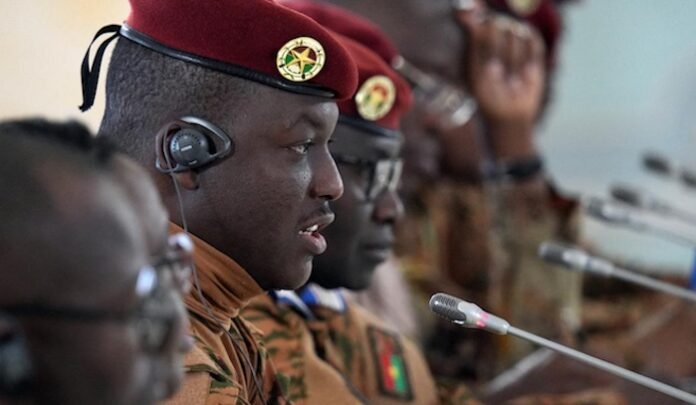
Burkina Faso’s presidency announced Thursday that all political parties have been dissolved and laws governing their operations repealed.
The sweeping measure marks a dramatic restructuring of the country’s political system under junta leader Ibrahim Traore, who came to power in the September 2022 coup.
Traore presided over a council of ministers meeting where the decision was formally adopted. Minister of Territorial Administration and Mobility, Émile Zerbo, described the move as “a great and important decision as part of the re‑founding of the state.”
According to the presidency, the country’s numerous political parties have contributed to fragmentation, division among citizens, and a weakening of the social fabric.
“This decree aims to preserve national unity, enhance the coherence of government action, and pave the way for comprehensive political governance reforms,” the statement said.
All property belonging to the dissolved parties will be transferred to the state. Zerbo confirmed that draft laws to implement the measure will soon be submitted to the Transitional Legislative Assembly.
Political Landscape Before and After the Coup
Before Traore’s takeover, Burkina Faso had more than 100 registered political parties, with 15 represented in parliament after the 2020 general election.
Following the coup, parties were ordered to suspend their activities, leaving the country without formal political representation under the transitional government.
The dissolution now formalizes that suspension, effectively eliminating party politics during the transition period.
Alongside the political restructuring, the council of ministers approved a major economic and development initiative known as the Reliance Plan. Valued at FCFA 36 trillion (about $65 billion), the plan outlines national development projects scheduled between 2026 and 2030.
Officials said the plan is designed to boost economic growth, expand infrastructure, and improve social welfare across the country.
Observers note that Burkina Faso’s political upheaval mirrors a broader regional trend of military-led transitions in West Africa, where countries such as Mali and Niger have also experienced coups in recent years.
Analysts suggest the junta’s decision to dissolve political parties and pursue a unified governance framework is aimed at consolidating authority, preventing further fragmentation, and ensuring stability during the transitional period.
Despite concerns from international partners about democratic backsliding, Traore’s administration insists the restructuring is necessary for long-term unity and reform.
“The restructuring of political institutions is a step toward building a more cohesive and resilient state capable of addressing economic and social challenges effectively,” the presidency said.
Rate, Like 👍, Comment 💬, Share this article, Follow us on our social media handles, and Submit your own story to get featured and earn rewards!