

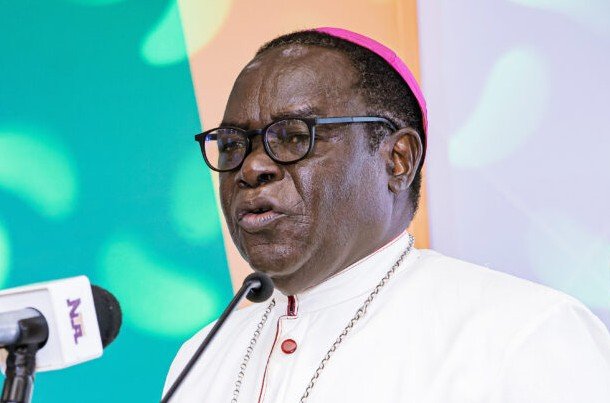
Bishop Matthew Hassan Kukah of the Catholic Diocese of Sokoto has expressed disappointment that Nigeria has made limited progress almost three years into President Bola Ahmed Tinubu’s administration.
Speaking on Sunday during a live Zoom edition of Boiling Point Arena, a platform for discussions on governance, accountability, and leadership, Kukah raised concerns about high food prices, widespread insecurity, and poverty.
“I am quite unhappy that we are still where we were on the issues of hunger, the sufferings, the mass sufferings in the land,” he said.
“I would have expected with the number of resources that are available, that we could develop enough capacity and imagination to do much more than just pushing money to governors, money that is still endlessly being wasted with very little impact on the ground.”
He lamented that despite Nigeria’s apparent wealth; many citizens continue to struggle. “The persistence of poverty amid what I consider to be plenty is alarming. Like joke, like joke, Nigerians are now finding it difficult to talk about millions. We’ve jumped from billions to trillions. But it’s not in the hands of the people,” Kukah added.
Insecurity Remains a Pressing Challenge
The cleric also highlighted the ongoing security crisis in the country, urging the government to act decisively.
“The second, and perhaps even far more important, is the persistence of the tragedy that has engulfed us in terms of our inability to rid ourselves of this banditry, the endless killings, and how life in Nigeria has become just so worthless,” he said.
“Those two critical issues make me sleepless, and they make me very uncomfortable. I encourage the government to take them much more seriously.”
Kukah noted that Nigeria has the capacity to address insecurity.
“The intelligence community can root out the murderers among us. The challenge is the perception that security agencies have become compromised. We need far more aggressive planning to end banditry and restore social order.”
Clarifying Comments on Christian Persecution
Responding to claims that he denied the killing of Christians in Nigeria, Kukah stated that he has never refuted such reports.
“I have never denied the killings of Christians in Nigeria. I don’t know where this idea came from,” he said. “If you read my lecture in Rome, you will see I raised the issue. Christians are suffering, and that should not have happened. My only clarification is that I’ve never denied the persecution of Christians in Nigeria.”
He added that Nigeria can seek assistance from anywhere to curb killings and criminality. “Wherever we can get help, Trump, whoever, we should get it; these killings ought not to have happened in the first place.”
Nigeria’s Transformation Depends on Citizen Engagement
Kukah maintained that the country can evolve if citizens commit to discipline, protest culture, and ethical governance.
“Most of the challenges we complain about are not peculiar to Nigeria. Nigerians must develop the capacity to resist. If we say we want a better society, government will respond to the pressure coming from ordinary citizens,” he said.
“We are not going to have a new Nigeria by lamentation. We are going to have it when we decide to play by the rules and make sacrifices.”
He also acknowledged the lingering effects of military rule and bureaucratic inefficiency.
“Every country is as good as its bureaucracy. An elite that is not prepared to play by the rules, to submit itself to discipline, prevents growth. What we are witnessing today is the result of our collective irresponsibility. The day we obey the laws, that’s when a new Nigeria will be birthed.”
Expert Views on Governance and Systemic Challenges
Oba Prof Saka Matemilola, Olowu of Owu Kingdom, who chaired the discourse, echoed Kukah’s concerns.
“Nigeria remains a struggling state despite its immense potential. Leadership failure is central, but it is not isolated,” he said. “We have had leaders who saw office as access to power and wealth while accountability remained weak. Economic growth exists on paper, but it has not translated into improved lives for millions of Nigerians.”
Matemilola warned against voter apathy and public cynicism. “The danger today is normalization of a dysfunctional system. Citizens and leaders alike must reflect on their responsibilities and demand accountability.”
The two-hour discussion was broadcast live on multiple radio stations across Lagos, Ogun, and Delta States, including WASH FM, Sweet FM, Roots FM, Ẹrimbe FM, Women Radio FM, and Kruzz FM.
Rate, Like 👍, Comment 💬, Share this article, Follow us on our social media handles, and Submit your own story to get featured and earn rewards!
 WhatsApp Channel
 Telegram Channel