


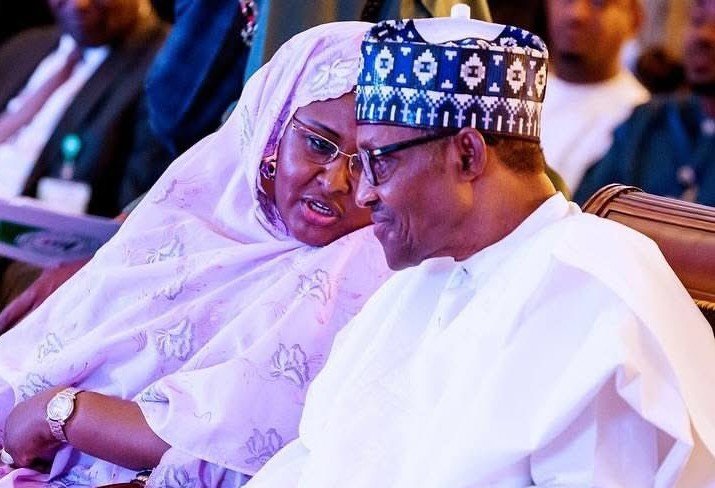
The former First Lady, Aisha Buhari, has said pneumonia—not cancer—was the illness that led to the death of her husband, former President Muhammadu Buhari.
She disclosed this in a new biography, From Soldier to Statesman: The Legacy of Muhammadu Buhari, authored by Dr. Charles Omole.
Buhari’s final days, she said, were physically demanding and emotionally traumatic for the family. The former president completed his eight-year tenure in his eighties and spent his last months battling serious health complications that required repeated hospitalisation in London.
“The final days were difficult. ICU for some days, then the ward, then the slide. The last three days were the worst,” Aisha Buhari recounted in the book.
She explained that Buhari’s final year after leaving office was marked by increasing medical travel and personal losses. According to her, phone calls became more frequent, and transatlantic trips intensified as the family moved between Nigeria and the United Kingdom.
“The family’s calendar was filled with funerals and flights,” she said.
Buhari had travelled to the UK, as he often did, to fix a tooth and enjoy the summer weather. Aisha remained in Abuja to mourn a nephew before returning to London.
Soon after, she flew back to Nigeria following the death of an uncle, further compounding the emotional strain of that period.
Buhari’s Illness and Final Moments
Aisha linked Buhari’s illness to his long military career and earlier lifestyle. She said he spent about 30 months as a soldier in the bush, mostly in the South-South region, often soaked by rain in uniforms that dried on his body.
Decades later, she believed that prolonged exposure to cold and harsh conditions weakened his lungs and bones, a condition worsened by office air-conditioning.
She also acknowledged that Buhari smoked earlier in life. According to her, age eventually compounded the damage, and pneumonia became the final illness.
During his last days, Buhari’s children moved in and out of hospital corridors, with one daughter spending the night before his death at his bedside.
When his condition deteriorated, doctors diagnosed acute pneumonia, a conclusion that did not satisfy public speculation about the cause of death.
“Pneumonia doesn’t usually kill people,” she said she was told.
She agreed but responded, “It can, especially with old age, and perhaps with a lifetime’s exposure to cold and dust in the field. He always coughed, even when he laughed.”
Aisha described the hospital environment as one where small physical changes carried meaning. She recalled a Gambian nurse advising that Buhari be repositioned to help ease pressure on his lungs.
When she attempted to lift his shoulders to place a pillow beneath him, she found she could not move his weight.
“They counted together, ‘One, two, three,’ but they couldn’t shift the weight,” she said. The pillow was eventually inserted from the side, and Buhari reassured her, “Yes, thank you,” when she asked if he was comfortable.
She said Buhari’s final days were marked by prayers, rotating bedside vigils by his children, repeated X-rays, and cautious optimism after sputum tests ruled out more severe diagnoses.
Doctors maintained that it was pneumonia but warned that the illness could be fatal at his age.
On the day Buhari died, Aisha said she informed him around 2 p.m. that she would briefly return home to rest, bathe, and pray before coming back.
He nodded in acknowledgment. With official vehicles already gone, she ordered an Uber and left the hospital.
At home, she said she felt an unexplained disturbance and urged her son, Yusuf, to return to the hospital. She later learned that Buhari’s breathing changed and stopped at about 4 p.m.
“We rarely arrive at the threshold of death before it happens. We only feel it as a tremor behind the door,” she said.
Cancer Rumors and Communication Failures
Aisha also addressed widespread reports suggesting that Buhari died of cancer, including pulmonary lymphoma or leukemia. She maintained that the official diagnosis communicated to the family was pneumonia.
She acknowledged that pulmonary lymphoma can resemble pneumonia in symptoms and scans, which may have led to public confusion.
However, she insisted that claims Buhari died of cancer were based on misinterpretation of leaked medical information.
Public reporting varied widely after Buhari’s death. Some outlets described a prolonged illness, while others referred to a brief one. Buhari was buried in Daura two days after his death.

The biography identified poor strategic communication as a recurring weakness of the Buhari administration, noting that silence often allowed rumors to flourish.
“Simple and banal developments were transformed into major conspiracies due to a lack of openness and effective communication,” the book stated.
Aisha agreed, saying unclear messaging left Nigerians confused until the very end.
“Rumors would begin, and stories would take on a life of their own. Nigerians did not know what to believe,” she said.
After Buhari’s death, Aisha said individuals who once controlled access to power felt exposed and unsettled. She insisted neither she nor her son sought revenge. According to her, the federal government’s takeover of burial arrangements prevented disorder.
“The state’s management of the burial logistics stabilized the ritual and limited opportunities for mischief,” she said.
She also revisited long-standing tensions within Aso Villa, describing it as an ecosystem where relatives, courtiers, and staff competed for influence.
“They tried to push everybody out, including me,” she said.
Her position, she concluded, was unequivocal.
“This is my house. You cannot be in charge of my husband’s office and then also be in charge of me, his wife, inside my house.”
Rate, Like 👍, Comment 💬, Share this article, Follow us on our social media handles, and Submit your own story to get featured and earn rewards!
 WhatsApp Channel
 Telegram Channel