



Nigeria’s headline inflation rate eased to 14.45 per cent in November 2025, down from 16.05 per cent in October, according to the latest Consumer Price Index (CPI) report released by the National Bureau of Statistics (NBS).
The figure represents a decrease of 1.6 percentage points month-on-month and marks a significant moderation compared to the same period last year.
On a year-on-year basis, headline inflation was 20.15 percentage points lower than the 34.60 per cent recorded in November 2024.
The bureau explained that the sharp decline reflects changes in the computation base year, noting that “the headline inflation rate on a year-on-year basis decreased in November 2025 compared to the same month in the preceding year, though with a different base year of November 2009 = 100.”
Despite the overall decline, the report showed that the pace of price increases rose slightly on a monthly basis.
The headline inflation rate stood at 1.22 per cent in November, higher than the 0.93 per cent recorded in October.
“This means that in November 2025, the rate of increase in the average price level was higher than the rate recorded in October 2025,” the bureau added.
Food and Core Inflation Trends Across States
Food inflation also recorded a decline on an annual basis, falling to 11.08 per cent in November from 39.93 per cent in November 2024.
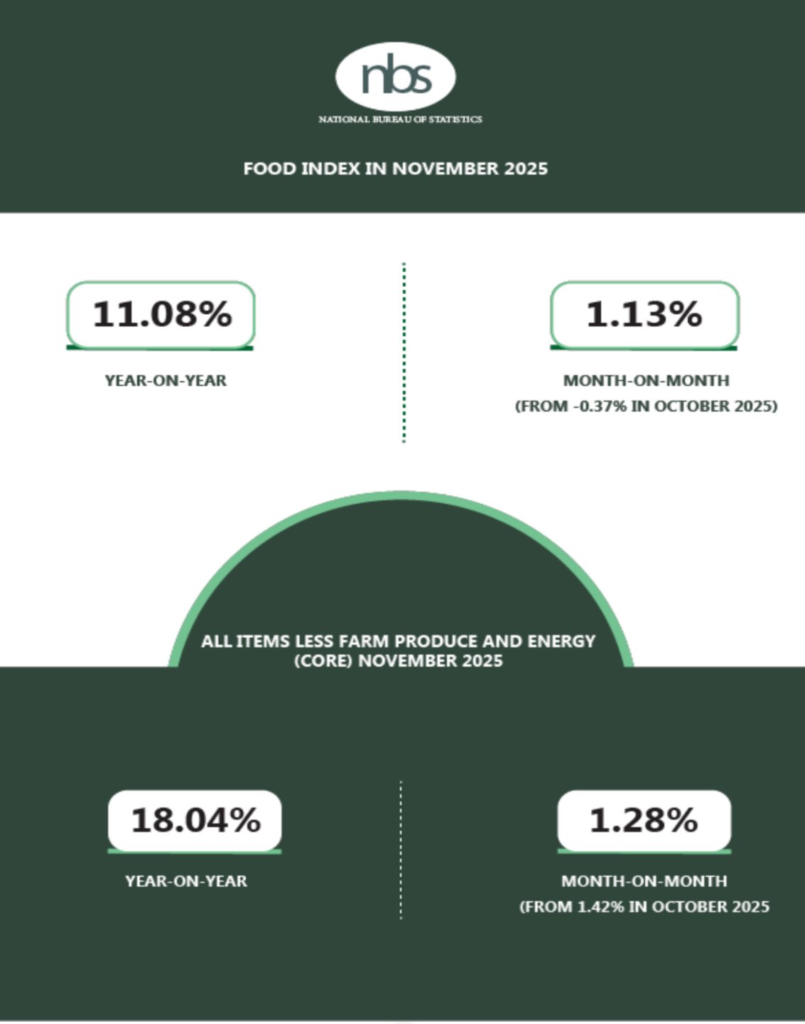
The NBS attributed the sharp drop to the change in the base year. However, on a month-on-month basis, food inflation rose to 1.13 per cent, compared to -0.37 per cent in October.
The increase was driven by higher prices of staple items including tomatoes, cassava tubers, periwinkle, pepper, eggs, crayfish, melon, oxtail, and onions.
Core inflation, which excludes volatile items such as energy and farm produce, stood at 18.04 per cent year-on-year in November, down from 28.75 per cent in November 2024. On a monthly basis, core inflation was 1.28 per cent, slightly lower than the 1.42 per cent recorded in October.
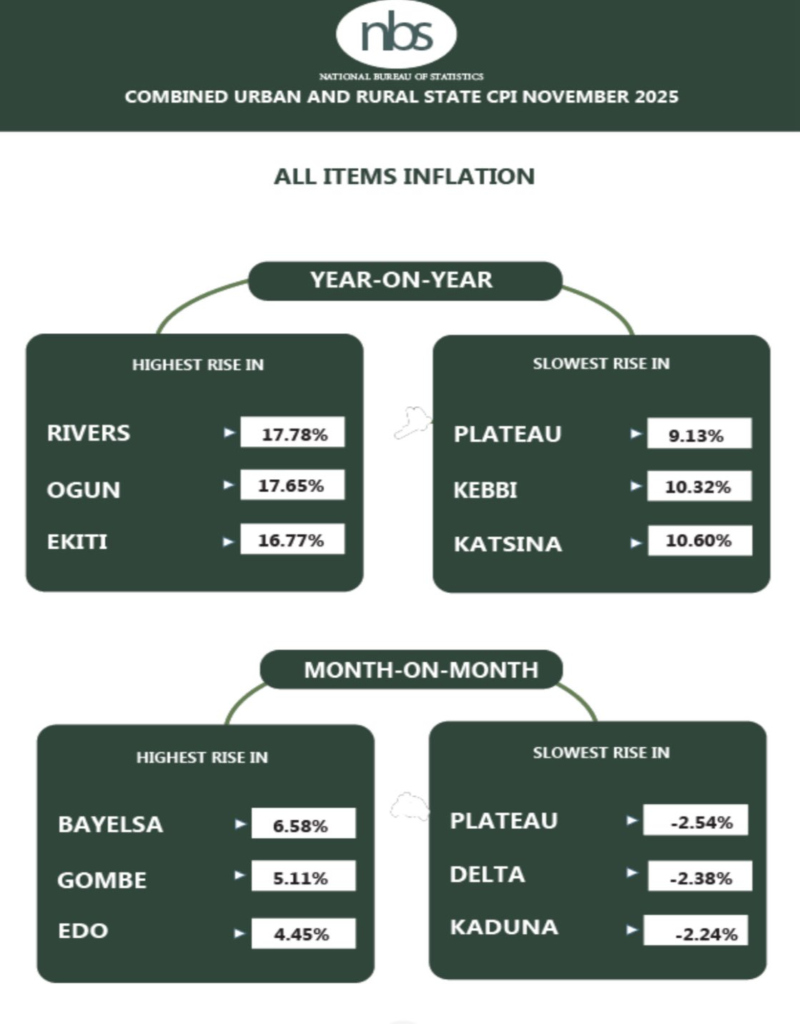
Across states, food inflation varied significantly. Kogi, Ogun, and Rivers recorded the highest year-on-year increases at 17.83 per cent, 16.52 per cent, and 16.11 per cent respectively. Imo, Katsina, and Akwa Ibom reported the lowest increases at 3.52 per cent, 3.65 per cent, and 4.52 per cent.
On a month-on-month basis, Yobe, Katsina, and Ondo recorded the highest increases, while Imo, Nasarawa, and Enugu experienced declines.
The NBS added that the average twelve-month annual inflation rate stood at 20.76 per cent for the period ending November 2025, representing a decrease of 5.88 percentage points compared with the 26.64 per cent recorded in November 2024.
Rate, Like 👍, Comment 💬, Share this article, Follow us on our social media handles, and Submit your own story to get featured and earn rewards!
 WhatsApp Channel
 Telegram Channel