



China has officially launched sales of the world’s first atomic‑based quantum computer, a milestone that moves quantum hardware out of research labs and into the marketplace.
The breakthrough system uses individual atoms arranged in optical lattices, functioning as stable qubits with far longer coherence times than traditional superconducting or ion‑trap designs.
That stability means fewer errors and deeper calculations, opening possibilities once thought unreachable.
Early demonstrations highlight its ability to run molecular simulations, encryption‑breaking scenarios, and optimization problems that strain classical supercomputers.
By manipulating atoms with ultra‑precise lasers, developers have achieved control that makes atomic qubits exceptionally reliable for real‑world applications.
A New Era of Commercial Quantum Access
For the first time, universities, corporations, and research institutions can purchase a fully functional atomic quantum computer rather than relying on cloud access.
This shift enables private quantum drug discovery, advanced materials research, AI acceleration, and next‑generation cybersecurity testing.
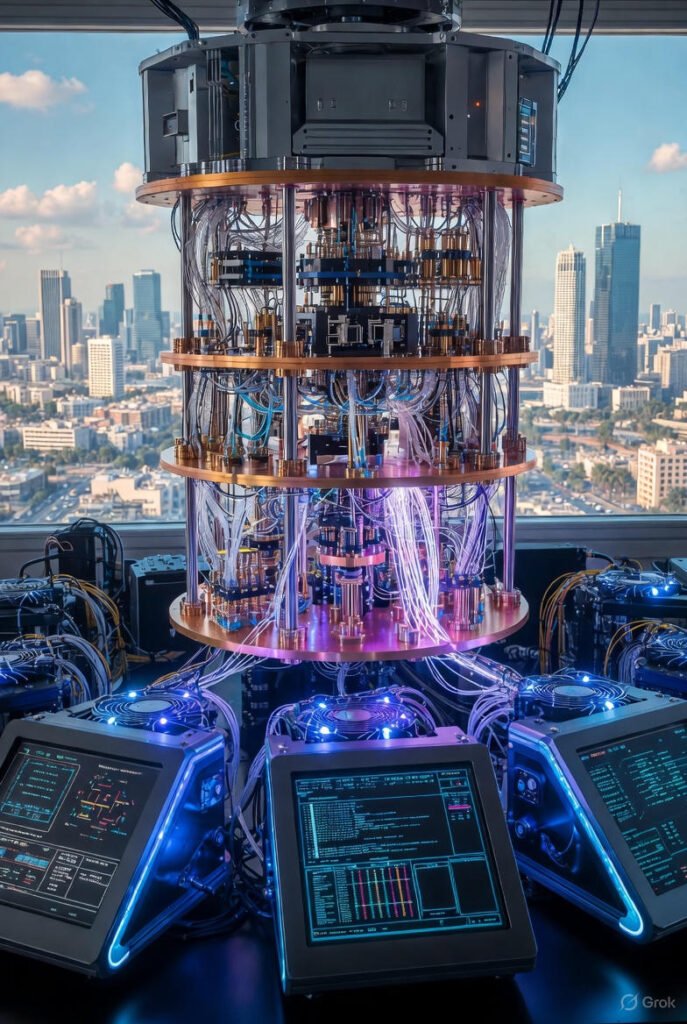
China’s aggressive move also signals its ambition to lead the global quantum race. The country has already invested heavily in quantum communication networks and satellite‑based encryption.
Analysts warn that selling atomic quantum machines could accelerate competition with the United States and Europe, where companies like IBM and Google continue to refine superconducting systems.
But What is Atomic Quantum Computing
For decades, quantum machines were confined to research labs, accessible only through cloud services or experimental prototypes. Now, with neutral atoms arranged in optical lattices serving as qubits, China has placed a fully functional quantum computer on the market.
The system, known as Hanyuan No. 1, is priced at more than 40 million yuan — roughly $5.6 million. That cost makes it a tool for governments, elite universities, and multinational corporations rather than private buyers.
Already, a China Mobile subsidiary and clients in Pakistan have placed orders, signaling the kinds of institutions likely to adopt the technology first: telecom giants, defense agencies, pharmaceutical companies, and advanced research centers.
What sets atomic quantum computers apart is their stability. Unlike superconducting or ion‑trap systems, atomic qubits can hold information far longer, reducing errors and allowing deeper calculations.
Developers use ultra‑precise lasers to manipulate atoms, achieving control that makes these qubits exceptionally reliable.
The difference is stark: while classical supercomputers rely on trillions of sequential calculations, atomic quantum systems can solve certain problems exponentially faster.
Google once demonstrated a quantum computer solving a task in 200 seconds that would take the fastest supercomputer 10,000 years.
The applications are vast. Drug discovery could accelerate as molecules are simulated at quantum precision. Materials science may benefit from the design of superconductors, batteries, and alloys.
Cybersecurity faces both promise and peril: quantum machines can test encryption resilience but also threaten current protocols.
Artificial intelligence could be optimized through quantum algorithms, while telecommunications may integrate quantum networks for secure communication.
China’s rollout is not only scientific but strategic. By selling atomic quantum computers commercially, Beijing signals its ambition to lead the global quantum race.
The United States and Europe continue refining superconducting systems, but China’s leap into atomic qubits may redefine technological power. Analysts warn this could become the new arms race — not nuclear, but quantum.
Rate, Like 👍, Comment 💬, Share this article, Follow us on our social media handles, and Submit your own story to get featured and earn rewards!
 WhatsApp Channel
 Telegram Channel