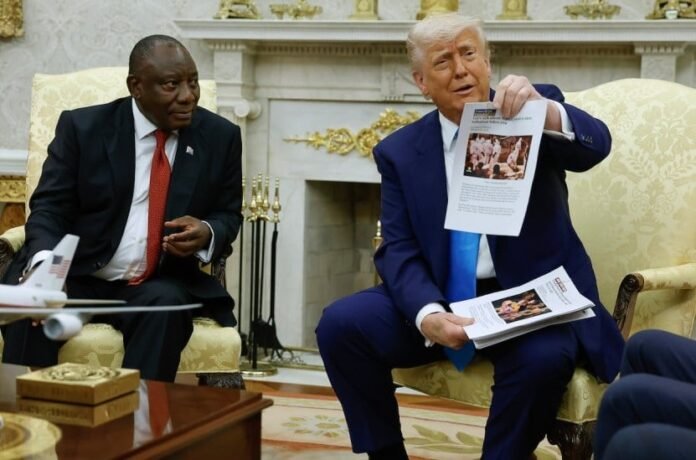
President Donald Trump has announced that the United States boycotted the 2025 G20 Summit in South Africa because of Pretoria’s “horrific human rights abuses” against Afrikaners and he vowed to block South Africa from attending next year’s G20 in Miami, Florida.
In a post on X, Trump complains that the South African government “refuses to acknowledge or address the horrific human rights abuses endured by Afrikaners, and other descendants of Dutch, French, and German settlers.”
He accused Pretoria of allowing farm seizures and violence against white citizens, describing the situation as “genocide”.
Trump further claimed that South Africa refused to hand over the G20 Presidency to a U.S. Embassy representative at the closing ceremony.
He made it clear that South Africa would not be invited to the 2026 G20 Summit scheduled to be hosted in Miami, Florida, under his watch.
He also pledged to halt all U.S. payments and subsidies to the country.
South Africa’s Response
But his remarks received an equally presidential rebuke from South African leader Cyril Ramaphosa. raising fears of a potentially escalating diplomatic clash.
South African President Cyril Ramaphosa strongly rejected Trump’s allegations, calling them “regrettable” and based on misinformation.
Ramaphosa emphasized that South Africa is a full G20 member “in its own right” and reaffirmed the country’s commitment to sovereignty, multilateralism, and constructive engagement.
Pretoria highlighted that the 2025 G20 Summit was widely praised by attending leaders and produced the “Johannesburg Declaration,” which focused on debt relief, climate resilience, and inclusive development.
South Africa insisted that Trump’s allegations misrepresented the realities of the summit and undermined global cooperation.
The Big Picture
The 2025 G20 Summit was historic as the first held on African soil, with leaders tackling issues of global debt, climate change, and industrialization.
China hailed the summit as a “victory for Africa,” while African Catholic bishops welcomed its resolutions on justice and inclusive growth.
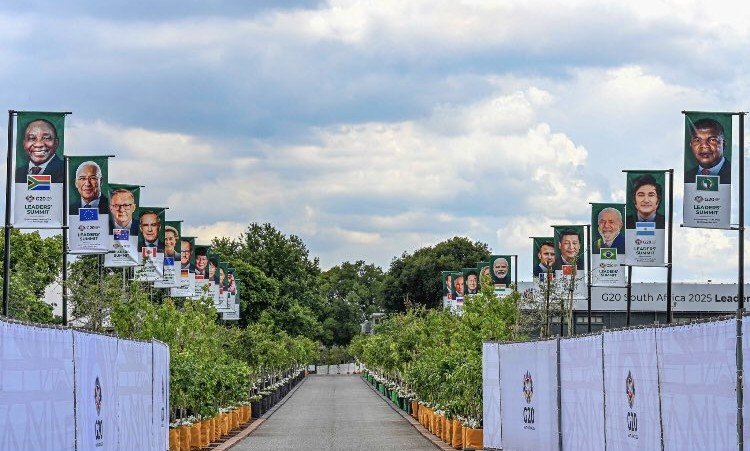
Trump’s boycott, however, marked a significant fracture in the multilateral order. Alongside Argentina, the U.S. absence underscored growing geopolitical tensions and highlighted the increasingly strained relationship between Washington and Pretoria.
Analysts note that U.S.–South Africa relations have deteriorated sharply in 2025, with disputes over trade, aid, and foreign policy contributing to what some describe as a “complete rupture” in ties.
Trump’s decision to exclude South Africa from the 2026 G20 Summit in Miami is causing concerns about the limits of U.S. presidential authority within an international G20 framework.
Some agree that while the host nation can influence invitations, South Africa remains a permanent member of the bloc, alongside 19 other leading economies, the European Union, and the African Union, which cannot be unilaterally excluded by any one member.
The back-and-forth reveals the fragile state of U.S.–South Africa relations and the bigger picture of the challenges facing global governance as the G20 seeks to balance multilateral cooperation with rising nationalist agendas.
Rate, Like 👍, Comment 💬, Share this article, Follow us on our social media handles, and Submit your own story to get featured and earn rewards!