


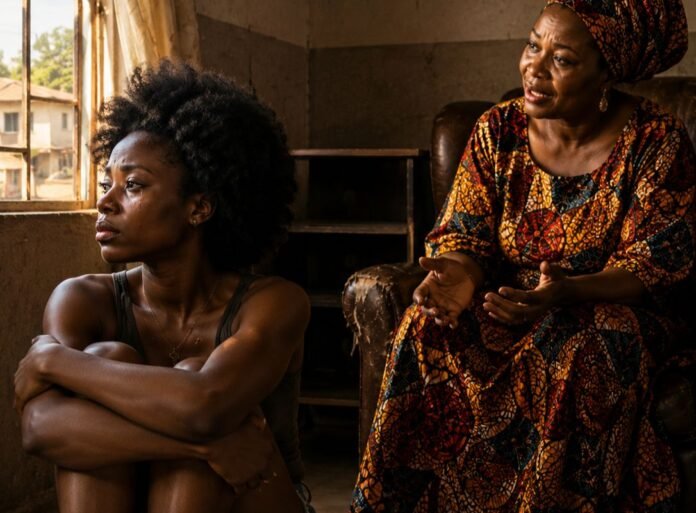

It is not a smile, not exactly. It is something quieter, and more dangerous than that — the way her eyes settle on me, unhurried, the way her throat moves in a slow swallow before she speaks, as though she is tasting her own hope before she offers it.
Sometimes, when she looks at me, I hear music. Not real music — something internal, ceremonial. The kind that plays when royalty walks into a room. She gives me that music. She crowns me with it every time she looks.
I have never told her that I am afraid of her eyes.
It was a Tuesday. 9 a.m. paper.
I had not read the night before — not because I was rebellious, but because NEPA had chosen war again, and the lecturer had not uploaded notes. Only links: YouTube videos, Instagram reels, a scattering of social media breadcrumbs meant to constitute a curriculum. I followed none of them. Not out of pride. Out of exhaustion — the particular kind that lives below sleep, the kind rest can’t touch.
On an empty stomach, I moved through the morning pressed between strangers who smelled of necessity and early hours, and I thought: why?
Not a rhetorical why. A genuine question.
Why education? Why this ritual of pretending — attending lectures that teach you nothing, submitting assignments that teach you less, emerging on the other side with a certificate and no guarantee that the world has a place for you?
Nigeria has a way of making the question feel rhetorical anyway.
My course mates were clustered outside the hall when I arrived — animated, rehearsing, asking each other questions like prayers. Some compared notes with the urgency of people who still believed it would matter.
I stood to the side.
Nobody noticed the way my hands shook. Nobody saw the slow, deliberate breaths — or the way my eyes kept filling and emptying, as if I were always on the edge of something I refused to cross. My mind was a browser with forty tabs open at once: debt, hunger, my mother’s eyes, the cost of living, and the question of whether any of this was worth surviving. All of it playing at once, none of it pausing.
Breathe, I told myself. Just breathe.
I moved when they moved. Sat when they sat. The invigilator asked me to remove anything that could implicate me in malpractice. I almost laughed. All I had was a pen, a clear card, a student ID, and a heartbeat. I had not even brought the ambition to cheat.
The question paper landed in front of me with a slam — the invigilator pressing it down as though to nail it to the table, as though it needed restraining. I looked at it. For one moment, I felt something like readiness.
Then I read the first question.
Air left me.
Not dramatically. Just quietly — the kind of silence the body makes when it realises the thing it feared is already happening, and there is nothing left to do. Something in my chest said, plainly: you have failed.
I laughed.
It came out unhinged, involuntary — the kind of laugh that is not really laughter but its skeleton, the sound a person makes when they have passed the point of grief and landed somewhere outside it.
My course mates looked up. Some of them, I would learn later, assumed I was laughing because the questions were easy. Because what else could it mean, a girl laughing at an exam? Brilliance, surely.
Oh, the irony.
The invigilator warned me. I stopped. I read the questions again — slowly, then quickly, then slowly again, as though speed could generate answers, as though rereading could turn ignorance into knowledge.
My head throbbed. The two invigilators had begun a conversation that grew louder with each passing minute, one of them singing, the sound of it like needles.
I pressed both hands to my ears.
But you cannot block sound and still write. You cannot hold down a paper with closed fists. I put my hands down. I pushed through. I wrote something — I am not sure what. Scribbles that filled the page.
The invigilator wandered past at one point, glanced at my paper, and said, unprompted, “first class material.”
I did not know whether to cry or disappear.
I was the first to submit.
The hall watched me stand — the shock of it visible, the irony complete. They had studied. I had not. I finished first. In any world that made sense, this would mean something. In the academic world, the first can be the last.
Outside, the air hit me like release. Not pride. Not relief, exactly — more like the feeling of escaping a room that had been slowly filling with smoke.
On my way home, I understood something I did not yet have words for: that you can be surrounded by water and still burn. That a person can be physically present in every room and genuinely absent from all of them.
I went home. I lay down in my room — the one place that is mine, the one place I can control — and I slept.
But before I slept, I thought of my mother.
Her eyes. That look. The slow swallow. The music she gives me that I have not yet earned.
There is a particular loneliness in being someone’s hope. In knowing that what she sees when she looks at you is not who you are, but who she needs you to become — and not knowing if those two people will ever meet.
I have not told her about the exam. I have not told her about the shaking hands or the maniac laugh.
I will not tell her.
Because hope, I am learning, is not always honest. Sometimes it is simply necessary. And sometimes the kindest thing you can do for someone who has placed their faith in you is carry it quietly, even when you are not sure you deserve it.
Even when you are not sure you will survive it.
-END=
From the table of the "Friendly Poet", Chinonso Achugbu


Oh a very beautiful poem. Initially, I was thinking the title didn’t fit until I saw the last paragraphs. Beautifully done. Kudos to you!
Thank you.