
A Department of Defense source have reportedly said the US military is prepared to launch strikes against Iran as early as this weekend, but that President Donald Trump has not yet made a final decision on whether to authorize the military action.
The White House has been briefed that forces could be ready following a buildup of air and naval assets across the Middle East.
One source said that Trump has argued both for and against military action, consulting advisers and allies as he weighs options.
“He is spending a lot of time thinking about this,” the source said, according to an online news media.
Senior national security officials met Wednesday in the White House Situation Room. Trump was also briefed by envoy Steve Witkoff and his son-in-law Jared Kushner on indirect talks with Iranian representatives held in Geneva.
Those discussions lasted more than three hours. Iran’s top negotiator said a “set of guiding principles” was agreed, but a U.S. official cautioned that “there are still a lot of details to discuss.”
Diplomacy and Military Posture
White House press secretary Karoline Leavitt said Iran was expected to clarify its negotiating position “in the next couple of weeks.”
She declined to indicate whether Trump would delay military action during that period. “I’m not going to set deadlines on behalf of the president of the United States,” she said, adding that “diplomacy is always his first option.”
US Secretary of State Marco Rubio is scheduled to travel to Israel on February 28 to meet Prime Minister Benjamin Netanyahu and provide an update on the talks.
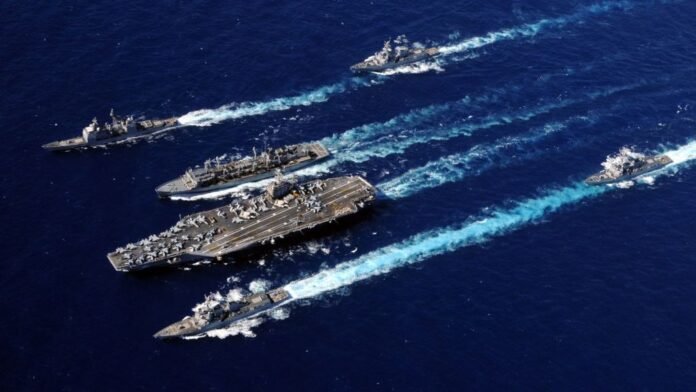
Meanwhile, the Pentagon has expanded its military posture. The USS Gerald Ford, the most advanced aircraft carrier in the U.S. arsenal, is expected in the region this weekend.
Over 50 fighter jets have been deployed to West Asia, repositioned from bases in the United Kingdom. Refuelling tankers and support aircraft are also moving closer to the Middle East.
Iran has fortified several nuclear and military facilities. Satellite images show concrete shields and soil layers covering sensitive sites, including the Parchin complex.
Tunnel entrances at another nuclear site have been buried. Analysts say these measures are designed to withstand aerial bombardment.
Supreme Leader Ayatollah Ali Khamenei rejected U.S. demands to halt uranium enrichment and limit ballistic missiles.
He said Iran has a “right to have a nuclear industry” and described possession of deterrent weapons as “essential and obligatory.”
Regional and Global Reactions
Russia has urged restraint, warning of unprecedented escalation. Moscow said U.S. warship deployments near Iran risk destabilising the region. Russian naval forces conducted manoeuvres with Iran in the Gulf of Oman this week.
Diplomatic timing may influence Trump’s decision. The Winter Olympics conclude Sunday, and Ramadan began Wednesday, raising sensitivities among Middle Eastern allies.
Trump is also set to deliver his State of the Union address on Tuesday, where aides say he will outline his domestic agenda.
Despite firm rhetoric on preventing Iran from obtaining nuclear weapons, Trump has offered limited detail on objectives should military action be ordered.
His public remarks have not secured broad support from Congress or the American public for a large-scale operation.
Rate, Like 👍, Comment 💬, Share this article, Follow us on our social media handles, and Submit your own story to get featured and earn rewards!