


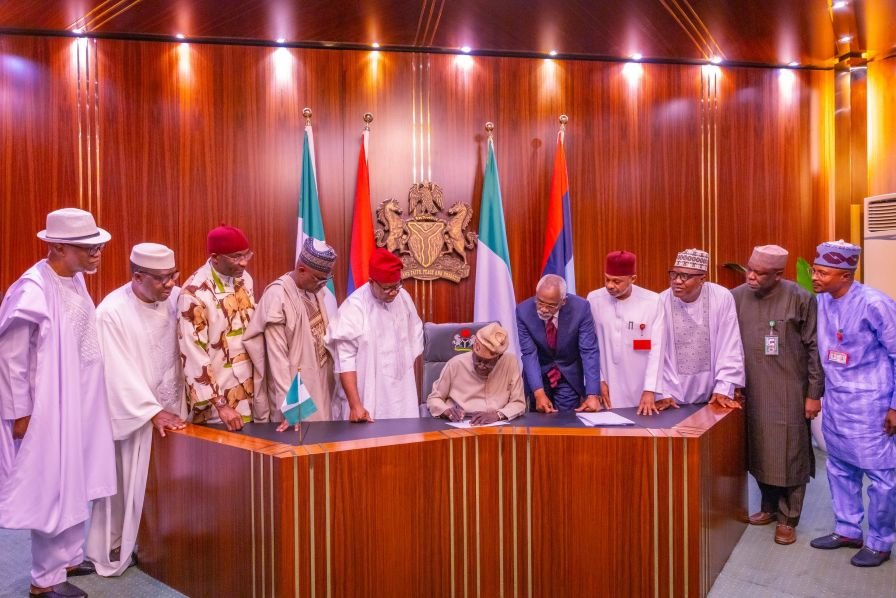
President Bola Tinubu has signed the Electoral Act 2022 (Repeal and Re-enactment) Bill 2026 into law, clearing the legal path for Nigeria’s 2027 general elections.
Bola Ahmed Tinubu assented to the bill at about 5:00 pm at the State House in Abuja, less than 48 hours after its passage by the National Assembly.
The signing ceremony was attended by Godswill Akpabio, Abbas Tajudeen, Deputy Speaker Benjamin Kalu, Senate Leader Opeyemi Bamidele, and Chief of Staff Femi Gbajabiamila.
The new law replaces the Electoral Act 2022 and takes immediate effect. It now forms the framework that Independent National Electoral Commission will use to conduct the 2027 polls.
Tinubu said the legislation was designed to prevent confusion and protect voters.
“What is crucial is that you manage the process to the extent that there will be no confusion and no disenfranchisement of Nigerians, and we are all going to see democracy flourish,” he said.
He added that elections depend on people, not machines.
“No matter how good a system is, it is managed by people, promoted by people and finalised by people. You are not going to be talking to a computer; you are going to be talking to human beings who announce the results.”
He also warned against relying solely on technology.
“Essentially, what we are looking at is the transmission of manual results, and we must avoid glitches. Nigeria will flourish and continue to nurture this democracy for prosperity and stability.”
Key Changes in the Electoral Act 2026
One major adjustment reduces the notice period for elections from 360 days to 300 days. This gives INEC more flexibility in scheduling and could allow national elections to hold in January 2027, potentially avoiding Ramadan.
The law gives statutory recognition to the Bimodal Voter Accreditation System (BVAS) and the INEC Result Viewing Portal (IReV). During the 2023 elections, both technologies were widely discussed amid disputes over transmission delays.
Electronic transmission of results remains part of the process. However, where networks fail, manually completed Form EC8A will serve as the fallback.
The Act also strengthens sanctions for collation infractions and reinforces safeguards against overvoting. It provides for digital verification of party membership registers.
Indirect primaries have been abolished. Political parties must now select candidates through direct primaries or consensus.
Supporters say the amendments reflect Nigeria’s infrastructure realities. Critics argue the removal of explicit “real-time” transmission language creates grey areas.
Opposition, Civic Groups React
The People’s Democratic Party described the amendment as a betrayal of voter expectations.
In a statement signed by National Publicity Secretary Ini Ememobong, the party said: “The anti-democratic stance of the Senate and the sudden somersault by the House of Representatives on the amendment of the Electoral Act 2022… is an act of treachery against the Nigerian electorate.”
The party faulted the restriction of primaries to direct and consensus methods. It said this intrudes into internal party affairs.
The Labour Party caucus in the House of Representatives also criticized what it called a rushed assent.
Caucus leader Afam Ogene said: “It is quite interesting that, even before the ink… dried up, the President has gleefully put his imprimatur on the bill.”
He added: “Gone with the signing are the genuine concerns of apprehensive Nigerians regarding what the new Act portends to the integrity of the country’s future elections.”
Former SDP presidential candidate Adewole Adebayo described the law as a “planned hatchet job.” He said democratic forces would explore constitutional options.
Civil society coalition groups have taken different positions. The Coalition for Good Governance praised the President for signing the bill within 24 hours, calling it patriotic.
Meanwhile, the Movement for Credible Elections rejected what it called the dilution of electronic safeguards.
Civic advocate Akindeji Aromaye of EiE Nigeria said it would be “dishonest to describe this law as entirely without merit.” However, he questioned the undefined “failure” clause on transmission and called for clearer INEC protocols.
With the 2027 elections approaching, implementation now becomes critical, and the credibility of the process largely depends on the umpire now loaded with considerable discretionary latitude.
Rate, Like 👍, Comment 💬, Share this article, Follow us on our social media handles, and Submit your own story to get featured and earn rewards!
 WhatsApp Channel
 Telegram Channel