

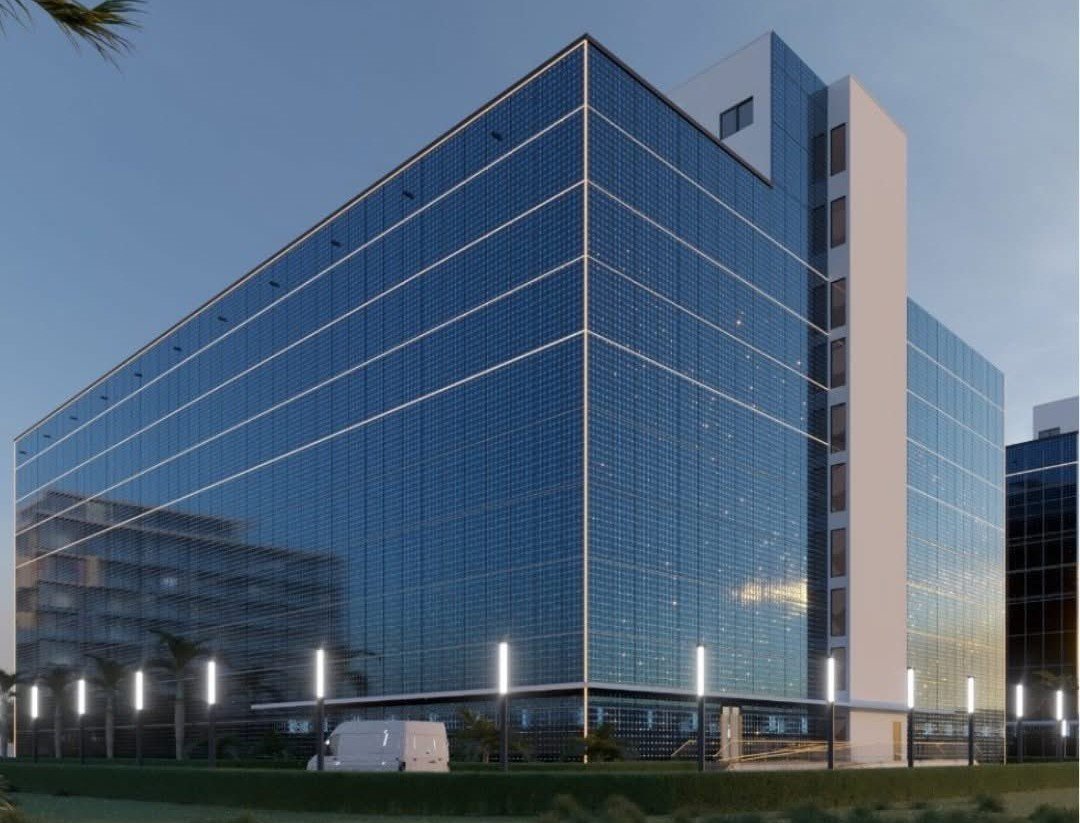
A new technological landmark is emerging along the Lagos–Calabar coastal road: the Kasi Cloud campus, a 42-hectare facility designed from the ground up to host high-density artificial intelligence (AI) workloads.
Unlike Nigeria’s existing 17 operational data centres, which rarely exceed 20 megawatts (MW) of capacity, Kasi Cloud is engineered for hyperscale AI, targeting 100 MW of sellable power across multiple buildings.
“This is not a retrofit. This was designed for AI from day one,” said Johnson Agogbua, CEO of Kasi Cloud, during a tour of the site on January 25, 2026.
Construction began in the second quarter of 2023, following the $250 million groundbreaking in April 2022.
The first building, six stories tall, will host 32 MW of capacity, with 5.5 MW set to begin operations in April 2026.
Power and Resilience at Scale
The campus is built around the principle of power first. Four independent high-voltage feeds, modular busbars, and dry-type transformers ensure full redundancy, allowing operations to continue even in case of outages.
Data halls are designed for 10–100 kW per rack, far exceeding existing Lagos facilities, and include reinforced floors, high ceilings, and liquid-cooling infrastructure.
Cooling systems rely on magnetic-drive technology and triple HEPA filtration to manage heat efficiently, while lithium-ion batteries provide reliable, long-lasting backup power.
Fire suppression systems are multi-layered, combining gas, chemical agents, and sacrificial modules for maximum safety.
Beyond the data halls, Kasi Cloud includes a meet-me room larger than some entire Nigerian data centres, fibre ducts buried 1.8 metres underground, and space for future telecom interconnections.
The campus is designed to allow phased expansion while minimizing disruption for tenants.
“This is about long-term discipline, not incremental shortcuts,” said Ngozika Agogbua, Global Director of Marketing and Sales Operations.
Kasi Cloud aims to position Nigeria as a hub for regional AI development, enabling data sovereignty, reducing foreign bandwidth costs, and supporting cloud-native product development within the country.
The facility is envisioned as more than a single data centre; it is a digital ecosystem including complementary infrastructure, service providers, and network operators.
“Why should you step into Malaysia and see world-class, then come to Nigeria and accept less?” Johnson Agogbua asked. For Kasi Cloud, capability is not a constraint; intent and discipline are.
Rate, Like 👍, Comment 💬, Share this article, Follow us on our social media handles, and Submit your own story to get featured and earn rewards!
 WhatsApp Channel
 Telegram Channel