


BUA Foods Plc, Nigeria’s most valuable listed company, has reported a record-breaking profit for 2025, underscoring how improving currency stability is beginning to ease pressure on corporate balance sheets.
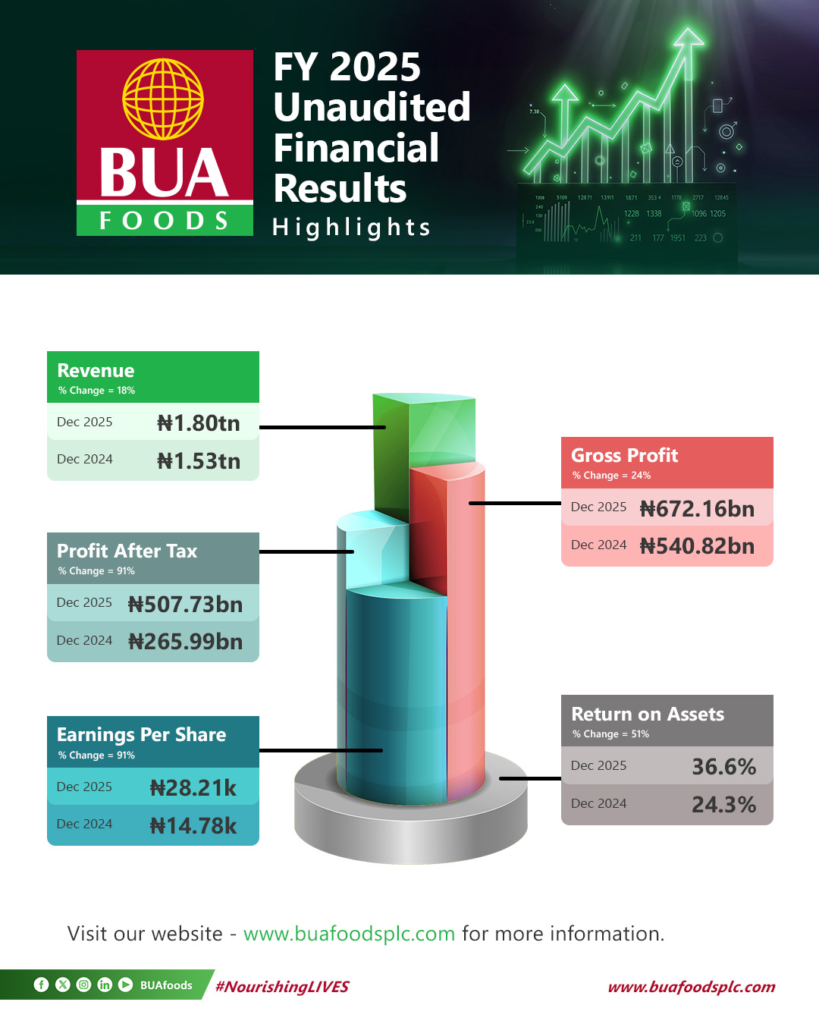
The Lagos-headquartered food producer posted a net profit of ₦507.7 billion, nearly double the ₦266.0 billion earned in 2024.
The surge was largely driven by a sharp fall in finance costs, which plunged to ₦21.9 billion from ₦203.2 billion a year earlier, according to unaudited results filed on the Nigerian Exchange.
The turnaround reflects reduced foreign-exchange losses and lower borrowing costs as the naira gained 7.5% toward the end of the year—the first annual appreciation in more than a decade.
Improved FX liquidity, tighter monetary conditions, and slower depreciation reduced translation losses and the need for costly short-term funding.
Revenue rose 18.1% to ₦1.80 trillion, supported by higher volumes and pricing across sugar, flour, pasta, and rice.

While cost pressures remained elevated—selling and distribution expenses climbed to ₦68.7 billion and administrative costs to ₦40.5 billion—these increases were outweighed by revenue growth and lower financing drag.
Operating profit rose to ₦565.4 billion from ₦472.1 billion, while gross profit reached ₦672.2 billion, reflecting scale advantages and resilient demand for staple foods.
Segment Performance and Cash Flow
Sugar, bakery flour, and pasta remained the company’s core segments, accounting for more than two-thirds of turnover. Sugar sales alone exceeded ₦755 billion, benefiting from domestic refining capacity at a time when import substitution remains a policy priority.
Operating cash flow strengthened to ₦311.6 billion, enabling BUA Foods to fund working capital, service debt, and pay ₦234 billion in dividends without materially increasing leverage.
Total assets expanded to ₦1.39 trillion, while shareholders’ equity rose to ₦702.8 billion, reinforcing balance-sheet resilience.
The performance stands out in a consumer sector still grappling with inflation, high energy costs, and fragile demand. Staple food producers, however, continue to benefit from population growth and limited substitutes, insulating volumes even as prices rise.
Risks remain, particularly around FX stability, which is recent and fragile. Rising inventories and receivables also point to higher working-capital intensity, a potential drag if credit conditions tighten further.
For now, BUA Foods’ results provide one of the clearest signals that Nigeria’s improving macroeconomic conditions are translating into tangible corporate earnings relief.
If naira stability holds, the company’s scale and operating leverage position it to extend its lead on the Nigerian Exchange in 2026.
The strong profitability run has boosted investor sentiment, with BUA Foods’ stock gaining 92.5% in 2025 to push its valuation to nearly ₦15 trillion. The shares closed at ₦798.90 on Wednesday, January 28, 2026.
Rate, Like 👍, Comment 💬, Share this article, Follow us on our social media handles, and Submit your own story to get featured and earn rewards!
 WhatsApp Channel
 Telegram Channel