

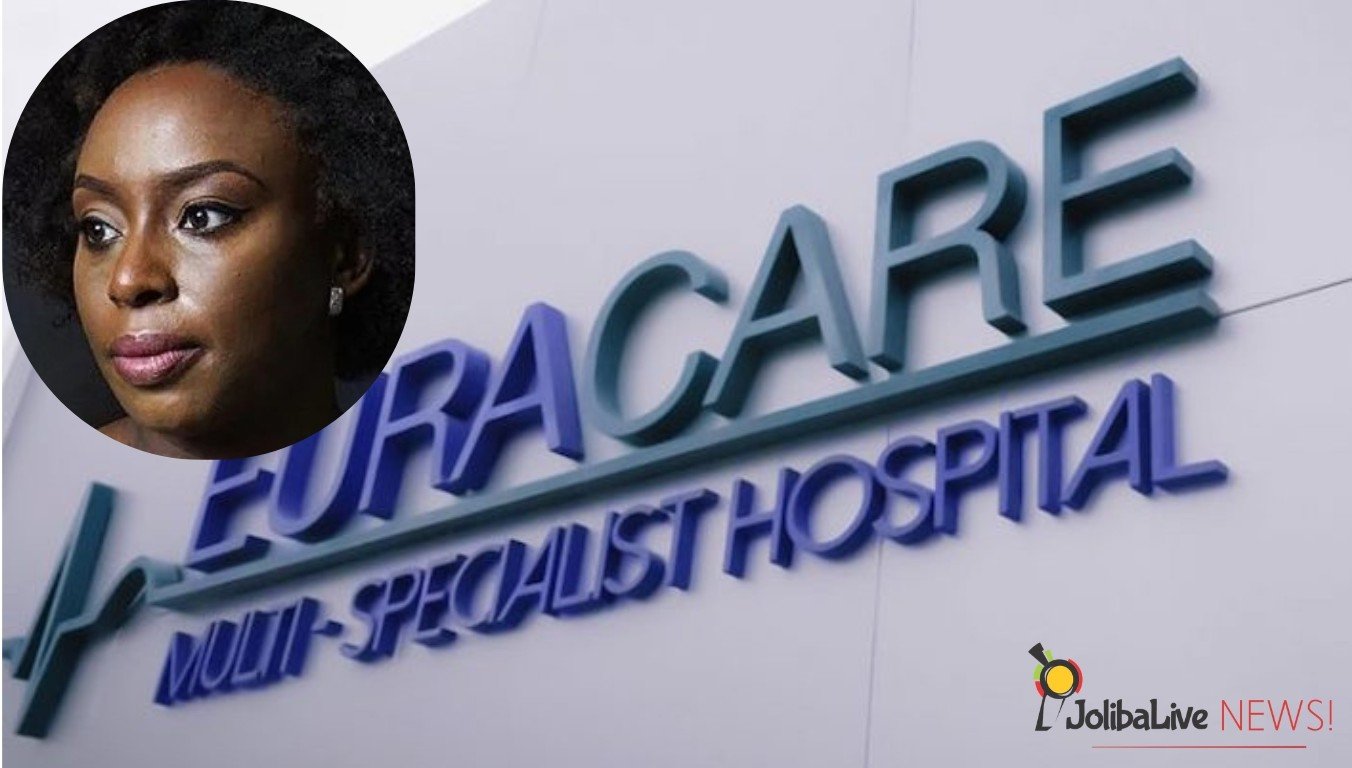
Renowned Nigerian author Chimamanda Ngozi Adichie has formally accused Euracare Multi-Specialist Hospital in Lagos of medical negligence following the death of her 21-month-old son, Nkanu Nnamdi Esege, raising fresh national concern about patient safety and accountability in Nigeria’s healthcare system.
The allegation triggered swift government attention, with Lagos State Governor Babajide Sanwo-Olu ordering an official probe into the circumstances surrounding the child’s death. The development followed widespread public reaction after details of the incident emerged.
In a detailed legal notice dated January 10, 2026, lawyers representing Adichie and her husband, Dr. Ivara Esege, accused Euracare, its anaesthesiologist, and other medical staff of breaching their duty of care.
According to the notice, their son died in the early hours of January 7, 2026, after undergoing several diagnostic and preparatory medical procedures at the hospital.
“These actions constitute prima facie breaches of the duty of care owed to the patient,” the solicitors stated.
The law firm issuing the notice is led by Professor Kemi Pinheiro, SAN.
The notice explained that the child, born on March 25, 2024, was referred to Euracare on January 6 from Atlantis Pediatric Hospital. The referral was made ahead of a planned medical evacuation to the United States, where a specialist medical team was reportedly on standby.
The procedures carried out included an echocardiogram, brain MRI, insertion of a peripherally inserted central catheter, and a lumbar puncture. Intravenous sedation was reportedly administered using propofol.
Alleged procedural failures and demand for hospital records
The legal notice alleged that serious complications arose while the child was being transferred from the MRI suite to the cardiac catheterisation laboratory.
Despite being under sedation, the child was reportedly moved across clinical areas under conditions that raised “serious and substantive concerns” about adherence to patient-safety protocols.
He was later pronounced dead in the early hours of January 7.
The parents alleged multiple lapses in paediatric anaesthetic care, including concerns over the cumulative dosing of propofol in a critically ill child.
They also raised issues around inadequate airway protection, failure to ensure continuous physiological monitoring, and poor compliance with paediatric transfer standards.
According to the notice, the child was allegedly transferred without supplemental oxygen, without adequate monitoring, and without sufficient accompanying medical personnel.
Concerns were also raised about delayed recognition of respiratory or cardiovascular distress and the alleged absence of basic resuscitation equipment.
Another grievance involved what the parents described as a failure to adequately disclose the risks and side effects of propofol and other anaesthetic agents, which they said undermined informed consent.
As part of their legal demands, the parents requested certified copies of all medical records related to their son’s treatment within seven days.
These included admission notes, consent forms, anaesthetic charts, drug administration records, monitoring logs, ICU notes, incident reports, and the identities of all staff involved.
The hospital was also instructed to preserve all relevant evidence, including CCTV footage, electronic monitoring data, pharmacy records, emergency equipment logs, and internal communications.
The solicitors warned that any alteration or destruction of evidence would be treated as obstruction of justice.
Family challenges Euracare’s public statement
The deceased child’s aunt, Dr. Anthea Esege Nwandu, publicly disputed Euracare’s statement released on January 10, 2026.
Dr. Nwandu is a dual board-certified Internal Medicine physician with three decades of clinical experience in Nigeria and the United States.
In a separate statement, Chimamanda Ngozi Adichie accused the hospital’s anaesthesiologist of gross negligence.
“The anesthesiologist was criminally negligent. He was fatally casual and careless with the precious life of a child. No proper protocol was followed,” she said.
Responding to Euracare’s claim of inaccuracies in the family’s account, Dr. Nwandu asked pointedly, “Which inaccuracies exactly?”
She said she identified what she described as significant falsehoods in the hospital’s version of events.
“Euracare claims the child had received care at two paediatric centres. This is false,” she said. “He was in one hospital before coming to Euracare.”
She also challenged the hospital’s claim of compliance with international medical standards.
“International standards demand that a child on oxygen who is sedated must have continuous oxygen therapy. Did Euracare do this? No,” she said.
She added that continuous monitoring of oxygen saturation, pulse, and respiration was required but allegedly not provided.
“When moving a sedated child, resuscitative equipment like an ambubag must accompany the patient. Did Euracare do this? No,” she said.
Expert links tragedy to systemic healthcare failures
The controversy has reignited debate about medical negligence in Nigeria.
Director of the Abuja School of Social and Political Thoughts, Dr. Sam Amadi, discussing this matter in an Arise TV program on Sunday, said such cases point to systemic failure rather than isolated mistakes.
“I think it’s greater than epidemic proportion,” Amadi said in the interview.
He described negligence in Nigeria’s health sector as rooted in what he called a public policy triad of culture, professionalism, and accountability.
“There is a generalised inefficiency arising from a deeply rooted ethos of ‘anyhow’,” he said.
Amadi argued that many incidents stem from basic procedural failures, not medical complexity.
“These are failures to follow elementary due process,” he said.
He criticised the absence of safety checklists, noting that such systems are standard in advanced healthcare settings.
“You sedate a child, you must monitor the child. These are basic checklists,” he said.
On accountability, Amadi said weak enforcement allows negligence to persist.
“People don’t get punished. That’s the problem,” he said.
He urged Lagos State to set a strong example through thorough investigations and decisive sanctions.
“Once hospitals face massive damages, owners will enforce internal monitoring,” he said.
As investigations continue, the case has intensified scrutiny of Nigeria’s private healthcare sector.
Rate, Like 👍, Comment 💬, Share this article, Follow us on our social media handles, and Submit your own story to get featured and earn rewards!
 WhatsApp Channel
 Telegram Channel