


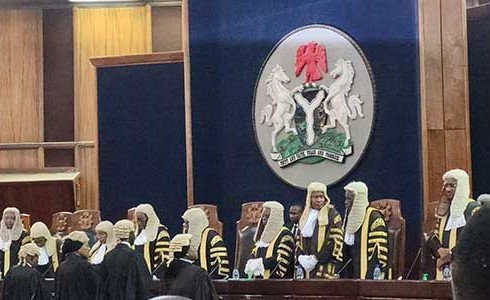
The Supreme Court has upheld the power of the President to declare a state of emergency in any state to prevent a breakdown of law and order or degeneration into chaos.
In a split six-to-one ruling, the apex court held that the President, during a state of emergency, can suspend elected officials, but such suspension must be for a limited period.
Delivering the lead judgment, Justice Mohammed Idris said Section 305 of the Constitution empowers the President to deploy extraordinary measures to restore normalcy. He noted that the section is not specific on the nature of such measures, thereby granting the President discretion.
The ruling arose from a suit filed by Adamawa State and 10 other PDP-led states challenging the propriety of President Bola Tinubu’s declaration of emergency in Rivers State, which saw Governor Siminalayi Fubara and other elected officials suspended for six months.
Justice Idris upheld preliminary objections raised by the Attorney General of the Federation and the National Assembly, ruling that the plaintiffs failed to establish a cause of action capable of activating the Supreme Court’s original jurisdiction.
He struck out the suit for want of jurisdiction, but also proceeded to determine the case on its merits and dismissed it.
Justice Obande Ogbuinya dissented, holding that while the President has the constitutional power to declare a state of emergency, such authority does not extend to suspending elected officials.
He argued that governors, deputy governors, and members of parliament cannot be removed under the guise of emergency powers.
Rate, Like 👍, Comment 💬, Share this article, Follow us on our social media handles, and Submit your own story to get featured and earn rewards!
 WhatsApp Channel
 Telegram Channel