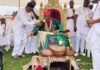






For nearly 20 years, one word divided the Igbo diaspora. That word was Eze Ndigbo. On a recent evening in Ikoyi, Lagos, it was retired.
Igbo leaders and Ohanaeze Ndigbo formally abolished the title Eze Ndigbo outside Igboland. They replaced it with Onyendu Ndi Igbo.
The change was sealed at the inauguration and presentation of the Lagos State chapter of the Association of Ndindu Ndigbo Nauzoije (ANNN).
The event marked the end of a long dispute. It also created a formal framework for Igbo cultural leadership in the diaspora.
Onyendu John-Greg Okey Ezegbuadi chairs the ANNN Lagos chapter. He said the occasion was not a routine ceremony.
“Today is not just an inauguration. It is the burial of confusion, and the birth of clarity,” he said. “Today is the end of an era of misconception and the beginning of an era of institutional legitimacy.”
The controversy was not minor. For decades, the Eze Ndigbo title was contested, misread and sometimes fought over. It split diaspora communities. It also drove a wedge between leaders abroad and traditional authorities at home.
“Many of us here have borne the brunt of that confusion,” Ezegbuadi said. “We were questioned, misunderstood, and our genuine efforts to serve our people were often misconstrued as an attempt to usurp authority. But we did not give up because we know that a house divided against itself cannot stand.”
The Committee That Ended 18 Years Of Dispute
The turning point came when the South East Governors’ Forum, Ohanaeze Ndigbo Worldwide and the South East Council of Traditional Rulers intervened. The council is also known as Ndi Eze Anaigbo Dum.
They set up the Committee on the Regularisation of Igbo Diaspora Traditional Title and Leadership (CRIDTTL). Chief Charles Odonukwe led it.
The committee called for memoranda, held consultations and screened submissions with what Ezegbuadi called “uncommon courage and impartiality.”
The committee settled on Onyendu Ndi Igbo. The title distinguishes diaspora leaders from hereditary royal fathers whose thrones remain in Igboland. Ezegbuadi said the resolution was not a demotion.
“It was an elevation through clarification,” he said. “It restored honour to the traditional institution at home while giving dignity and official recognition to those serving abroad.”
The decision was taken on May 29, 2026, at the Southeast Traditional Parliament in Owerri, Imo State. Ezegbuadi called that date “a new dawn in Igbo history.”
He said the certificates issued to the Ndindu were “the blood, sweat and tears of 18 years. A certificate of peace.”
Barnabas Chibuike Okoro is a legal practitioner and member of Ohanaeze Ndigbo, Badagry Chapter.
He told journalists the initiative was about structure, uniformity and clarity across Lagos and beyond. He said it was not about creating another layer of traditional rulership.
Okoro Explains Purpose of Gathering
“The essence of this gathering is to formally present the individuals who have been given these leadership titles to the various Igbo communities in Lagos,” he said. “These are the people approved to provide cultural leadership in their respective communities.”
Okoro explained the problem the exercise solves. In the past, individuals could emerge on their own and claim leadership of Igbo communities without endorsement from traditional institutions.
The new framework requires the Council of Traditional Rulers in Igboland to endorse each leader.
He drew a clear line between cultural leadership and royal office.
“Traditional rulership is a different matter and is regulated by law,” he said. “These positions are essentially about community and cultural leadership, rather than traditional rulership or royalty.”
The new leaders, he said, should not be addressed as His Royal Highness or His Majesty.
A New Standard Of Leadership
Prince Ubochi Ubochi is Secretary of the CRIDTTL. He said the event represented an institutional transition.
“The South East Council of Traditional Rulers has moved to provide a more clearly defined framework for Igbo traditional representation in the diaspora,” he said.
The committee, he added, handles screening, verification, assessment, documentation and recommendation of prospective Onyendu.
“So, today is really about responsibility, institutional recognition and a new standard of leadership,” Ubochi said.
He warned against replicating old rivalries. “We must not create another platform where everybody wants to be ‘the number one’. The Onyendu structure should be built around consultation, collective responsibility, orderly succession and rotation.”
The ceremony also featured the Igbo Traditional Values & Leadership Award 2026. It honoured individuals who served the Igbo community and preserved its heritage.
The theme was Igbo Unity, Culture, Tradition and Progress.

 WhatsApp Channel
 Telegram Channel