


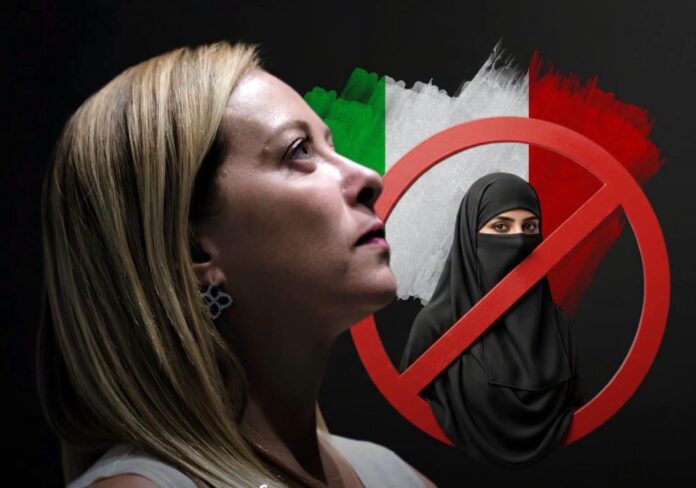
Italy is preparing legislation that would impose a legal limit on the number of foreign students in each classroom and prohibit face-covering veils in schools, Prime Minister Giorgia Meloni announced on Sunday, 20 September 2026.
Speaking at Fenix, a national youth festival organised by the youth wing of her Brothers of Italy (FdI) party, Meloni said a measure would soon be presented to the Council of Ministers.
The proposed law would establish a maximum number of foreign students per class, require parents of foreign students struggling with school integration to learn Italian, and ban the burqa and niqab on school premises.
‘Italian Children Cannot Feel Like a Minority‘
Meloni framed the initiative as a matter of fairness for Italian pupils.
“Italian children cannot feel like a minority in the classroom,” she said. “It’s unthinkable that in an Italian classroom, Italian children feel cornered because they’ve become the minority. It can’t be done“.
She went further in her address, criticising the approach to integration taken by previous governments.
“It is unacceptable that in an Italian classroom the children who end up feeling pushed into a corner are Italian children because they have become the minority,” she said.
“That cannot be allowed. Calling all this integration is yet another lie, a convenient lie for those who live off ideology“.
What the Measure Entails
According to Meloni’s announcement, the forthcoming legislation will include three core provisions:
- A statutory cap on the number of foreign students permitted in each class
- A language requirement obliging parents of foreign students with serious integration difficulties to learn Italian
- A prohibition on wearing burqas and niqabs in schools
The burqa is a full-body garment that traditionally includes a semi-transparent mesh over the eyes, while the niqab is a face veil that leaves only a slit for the eyes.
The hijab — an Islamic dress ritual is a headscarf covering the hair and neck while leaving the face visible — was mentioned by Meloni in earlier remarks, though the proposed ban as outlined focuses on full-face coverings.
Italy is not alone in restricting face coverings in public spaces. France introduced an outright ban on concealing one’s face in all public places, followed by Belgium.
Austria has applied similar rules to schools. In Spain and Poland, however, freedom of conscience and religion is constitutionally protected, creating a different legal landscape for such measures.


Honestly, it is your land, and territory, so your rules. Hopefully the stipulated numbers for foreign children in classrooms doesn’t affect the educational trajectory or foreign nationals.